Best Free GTO Tool for Beginners (2026): What Actually Works
I tested every free GTO option a beginner can realistically use in 2026. Here's what's worth your time, what's a trap, and how I'd start over today.
Best Free GTO Tool for Beginners (2026): What Actually Works
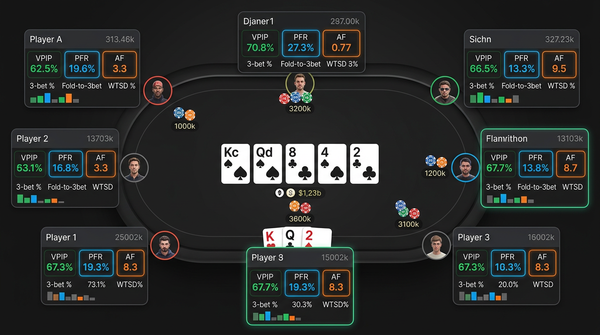
Last week a guy I coach sent me a screenshot of a hand and asked, "What does the solver say here?" He'd been studying for three months on a free trial of one of the big-name solvers, building trees, watching tutorials, the whole thing. The hand was a 3-bet pot, BTN vs BB, K72 rainbow flop, and he'd jammed turn with second pair on a brick. He thought he was making a "solver play." He wasn't even close.
That's the problem with free GTO tools for beginners. Most of them aren't designed for beginners. They're stripped-down versions of professional software, and what gets stripped out is usually the part that would have helped a beginner understand what they're looking at. You get the engine without the curriculum. So you end up running random spots, looking at colored grids, and convincing yourself you've learned something.
I've been playing 6-max NL online since 2017, climbed from microstakes to NL500, and I've been writing software reviews since 2022. I've watched the free-GTO market mature from "free" meaning "buy this $400 product to get the trial" to genuine browser-based tools that let a beginner actually study without spending a dollar. Some of them are great. Most of them aren't. And the worst ones will actively hurt your game by giving you confidence in solutions you don't understand.
This isn't a roundup of every free option ranked by feature checkboxes. This is what I'd hand to a friend who just finished reading Modern Poker Theory and asked, "OK, where do I actually start?" I'm going to tell you what to use, in what order, and what to avoid. I'll also tell you when "free" stops being enough and when paying $29 or $49 a month is unambiguously worth it.
A note on what "GTO tool" even means here. I'm including pure solvers (input a spot, get a solution), preflop range trainers (memorize and drill RFI/3-bet ranges), and EV/equity calculators that let you reason about specific decisions. All three are part of a beginner's GTO toolkit. Skip any one of them and you'll have blind spots.
What a Beginner Actually Needs Before Touching a Solver
Before I name names, I want to push back on the assumption that you should be using a solver at all if you're a beginner. I see this all the time in Discord coaching channels — someone who's never folded turn correctly in their life is asking about the EV difference between two 33% pot bets on a low-SPR turn. It's like asking which font your novel should use before you've written a paragraph.
Here's what you actually need first, in order:
-
A working preflop range you can recall instantly for every position. RFI ranges, 3-bet ranges (IP and OOP), 4-bet ranges, cold-call ranges. If you have to think about whether to open ATo from UTG at a full ring table, you're not ready for solvers. Get this down first. Free range charts are everywhere.
-
A basic mental model of how equity, position, and SPR interact. You should know why a 25% pot bet is different from a 75% pot bet, why position matters more on dry boards than wet ones, and why SPR 2 plays differently from SPR 8.
-
The ability to reason about a hand without software. If you can't articulate why you'd cbet K72r as the preflop raiser in a single-raised pot, no solver will save you.
Once those three are in place, GTO tools become extremely useful. Before then, they're a way to feel productive while not actually improving.
The reason I'm pounding on this: most "free GTO tool for beginners" content online assumes you should jump straight to a solver. You shouldn't. Use the first month of your study career on preflop ranges and basic concepts. Then come back to this article.
Tier 1: Free Tools You Should Actually Use
These are the four tools I'd put in a beginner's toolkit on day one. None of them cost anything. All of them do one thing well.
GTO Wizard Free Tier (browser, no install)
GTO Wizard's free tier in 2026 gives you access to a meaningful slice of pre-solved spots — typically 100bb cash, 6-max, with the most common preflop trees. You can't customize, you can't run your own sims, and you can't see deeper stack depths or non-standard sizings. But for a beginner, that's actually fine.
Here's why I list it first: the interface explains itself. You see ranges, frequencies, EV numbers, and you can click around without breaking anything. The "trainer" mode where you guess the GTO action and get scored is the single most useful free study feature on the internet right now. Spend 20 minutes a day playing it for two weeks and your turn defense will be measurably better.
Limitations: you're locked to specific tree configurations. If you want to know what changes when you make it a 3-bet pot at 60bb instead of an SRP at 100bb, you can't. You'll hit the wall in maybe 30–60 days of serious study. That's when you start thinking about paid options.
Equilab (desktop, free, ancient but still useful)
Equilab has been around forever. It's not a solver — it's an equity calculator. You input a hand, two ranges, and a board, and it tells you who's ahead and by how much. That's it.
For a beginner, this is gold. Most leaks at small stakes aren't GTO leaks — they're equity miscalculations. You think you're ahead when you're behind. You think your draw has more outs than it does. You think your bluff is "balanced" but actually you have zero hands in your range that beat villain's calls.
Run 100 hands through Equilab in your first month and you'll start to develop intuition for equity numbers that a solver alone won't give you. Set up "AA vs random hand on K72r" and notice how much equity you have. Then set up "AKs vs JJ-AA on QJ8 two-tone" and notice how much you have. Build the mental library.
Hand2Note Free Tier (HUD with limits)
OK, technically a HUD, not a "GTO tool." But the data a HUD gives you about your own play is the foundation everything else sits on. You can't fix leaks you can't see, and you can't see leaks without your own database.
Hand2Note's free tier in 2026 gives you a HUD with limited stats and a small database cap. For a beginner, that's enough for the first 50,000 hands. You'll see your own VPIP, PFR, 3-bet %, fold to 3-bet, and a handful of postflop stats. Cross-reference those against published "good player" benchmarks and you'll find your top three leaks in an afternoon.
I know PokerTracker 4 and Hold'em Manager 3 both have free trials too, but those are "free for 30 days" deals. Hand2Note's free tier is actually free indefinitely, just capped.
PokerSnowie Free Demo (limited but conceptually unique)
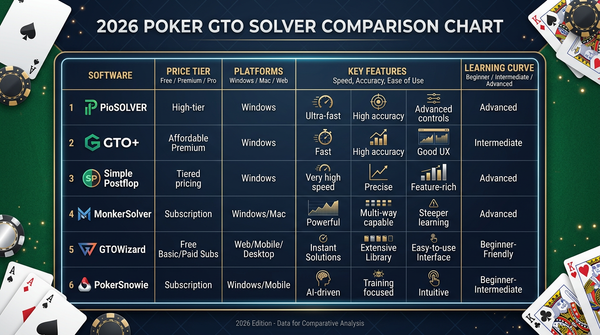
PokerSnowie's full version is paid (around $29/month in 2026), but the free demo is worth a session. PokerSnowie is a neural network trained to approximate GTO play, and unlike a normal solver, it gives you a verdict on every action: green for good, yellow for marginal, red for clear mistake. No tree-building, no input.
For a beginner who can't yet read a solver output, PokerSnowie's red/yellow/green system is much friendlier. You play hands, it tells you which ones you misplayed. Done. The demo lets you play a couple of sessions before pushing you to upgrade.
I don't recommend PokerSnowie as your only tool — it's an approximation, not a true solver, and serious players will eventually outgrow it. But for the first 30 days of GTO study, it's the most beginner-friendly thing on the market.
Tier 2: Free But Use With Caution
These tools are technically free, useful in narrow situations, but I see beginners burn enormous amounts of time on them without improving. Use sparingly, and only after Tier 1.
TexasSolver and Open-Source Solvers
There are open-source solvers floating around — TexasSolver being the most popular. Free to download, free to run, no subscription. Sounds great, right?
In practice, two problems. First, you have to build trees yourself, which means you have to already understand what tree configurations are reasonable. Beginners typically build absurd trees with too many sizings and too much depth, and the solver runs for two hours producing a useless result. Second, the visualization is rough. You get raw output but no didactic explanation, no comparable spots, no "here's what changes when X."
If you're a software engineer who wants to play with the underlying math, TexasSolver is fun. If you're a poker player who wants to improve, skip it for now and pay for GTO Lab or GTO Wizard once you outgrow free tools.
YouTube Solver Walkthroughs
Not a tool exactly, but worth mentioning because beginners use them as a substitute for solver work. Watching someone walk through a solver is fine for understanding what's possible. It's not a substitute for clicking around yourself. The brain does not retain "I watched a video about cbet frequencies" the way it retains "I drilled 100 cbet decisions and got scored."
Use solver YouTube as supplementary material, not primary study.
What Free Tools Cannot Teach You
I want to spend a whole section on this because it's the thing nobody warns beginners about. Free GTO tools have hard ceilings. Hit them, and you'll plateau hard.
Custom spots. Free tools give you canned solutions. The moment you want to know "what changes if villain's range is uncapped," or "what if I face an unusual sizing on the turn," you're stuck. Real learning happens when you compare slightly-different versions of the same spot to develop intuition for which inputs actually matter.
Multi-street EV reasoning. Free tools usually show you flop solutions and stop there. Turn and river are where most of your EV is bleeding away, and you can't study them properly without a real solver.
Node locking. This is the big one. "Node locking" means forcing villain's strategy at one decision point and seeing how your strategy should respond. It's how you adapt GTO theory to actual exploitative play against real opponents. No free tool I know of in 2026 lets you node lock at all.
Range-vs-range visualization beyond the basics. Once you start asking questions like "what's my range here after I check-call flop and check turn," free tools fall apart. The trees aren't deep enough.
This is why "free forever" isn't a viable strategy if you're serious. Free tools get you off zero. They get you to maybe a competent low-stakes regular. Past that, you need a real solver.
How I'd Sequence Six Months of Study Using Mostly Free Tools
If I were starting today as a beginner with $0 to spend on tools, here's exactly what I'd do.
Month 1: Preflop and equity. Memorize one published preflop chart system completely (Upswing's free charts work fine). Use Equilab daily to drill equity calculations on common spots. Don't touch a solver yet.
Month 2: GTO Wizard free trainer. 30 minutes a day in the trainer mode. Don't try to learn theory, just play and let the scoring tell you where you're wrong. Start to notice patterns: "I underbluff turn," "I call too wide vs 3-bets from the BB," etc.
Month 3: PokerSnowie demo + start a database. Install Hand2Note or any free tracker. Play your normal game, then end every session by running 5–10 hands through PokerSnowie. Pay attention to red flags and write down recurring themes in a notebook.
Month 4: Targeted weakness study. By now you should know your top 2–3 leaks from your database. Use GTO Wizard's free tier to drill those specific spots. If your fold-to-3bet is too high, drill 3-bet pots. If your turn play sucks, play turn-only sessions in the trainer.
Month 5: First paid trial. This is where I'd open a one-month trial of GTO Lab or GTO Wizard. Use it to answer the questions the free tier couldn't. Most beginners get one productive month out of a paid solver and then plateau again because they don't have a study system.
Month 6: Decide if you're committing. If after month 5 you've been studying consistently, you're ready to commit to a paid tool. If you've been sporadic, go back to the free tier — paying $50/month for software you use twice a week is worse than free tools used daily.
Comparison: Free GTO Tools at a Glance
| Tool | What it does | Free tier ceiling | Best for |
|---|---|---|---|
| GTO Wizard (free) | Browser solver + trainer | ~30–60 days serious study | Drilling preflop and common postflop spots |
| Equilab | Equity calculator | Unlimited (no real ceiling) | Building equity intuition |
| Hand2Note (free) | HUD + database | Capped database size | Self-analysis of your own play |
| PokerSnowie (demo) | Neural net coach | A few sessions | Beginner-friendly mistake detection |
| TexasSolver | Open-source solver | No ceiling, but steep learning curve | Engineers who want to tinker |
| YouTube walkthroughs | Educational | N/A | Supplementary learning |
| What you can study free | What requires paid |
|---|---|
| Preflop ranges (all positions, all formats) | Custom preflop trees |
| Single-street equity calculations | Multi-street solved trees |
| Basic cbet/check-back frequencies | Node locking and exploitative deviations |
| Common 3-bet pot spots at 100bb | Non-standard stack depths |
| Generic "what does GTO say" questions | "What changes if villain does X" questions |
| Cost of paid alternatives in 2026 | Monthly | Annual |
|---|---|---|
| GTO Lab | ~$49 | ~$399 |
| GTO Wizard | $49–$99 | varies by tier |
| PokerSnowie full | $29 | discounted yearly |
| InstaGTO | ~$29 | discounted yearly |
When Free Stops Being Enough
I get this question constantly: "How do I know when to upgrade?" Here's my honest answer.
If you've been studying consistently for 60–90 days using free tools, you can read solver output without confusion, you have a clear list of leaks you're working on, and you keep running into spots where the free tool can't answer your specific question — that's when. Not before.
The trap is upgrading too early. Beginners pay for GTO Wizard or GTO Lab, feel guilty for spending the money, then study erratically because they don't have the foundation to use it well. They get less out of $49/month than they would have gotten out of $0/month with discipline.
The other trap is upgrading too late. Players who genuinely outgrow free tools but refuse to pay end up developing weird workarounds, watching too much YouTube, building wrong intuitions. If you've been at it for six months and you're plateaued, the $49 is unambiguously worth it — that's roughly one buy-in at NL100. You'll make it back many times over.
A middle path I recommend: pay for one month of a full solver, study hard, then drop back to free for two months while you internalize what you learned. Repeat as needed. Most beginners don't need a continuous subscription. They need bursts of intense paid study followed by long stretches of repetition with free tools.
Setup Walkthrough: Your First Week
Let me give you a concrete plan for your first seven days, assuming you're starting from zero.
Day 1. Sign up for GTO Wizard free. Spend 60 minutes clicking around any 100bb 6-max preflop spot. Don't try to "learn" anything. Just see what the interface does, what colors mean what, where ranges live, how to navigate. The goal is comfort, not knowledge.
Day 2. Download Equilab. Run these 10 spots: AA vs random preflop, AKs vs QQ preflop, AKs on AK7 vs random, JJ vs AK on Q72r, 87s vs AKo on T96 two-tone, and five more of your choice. Write down the equity numbers in a notebook by hand.
Day 3. Pull a published preflop chart for 100bb 6-max RFI ranges. Copy the chart by hand into your notebook. Do not skip this step. Handwriting builds memory.
Day 4. GTO Wizard trainer mode, 30 minutes, preflop only. Play random spots and see what your accuracy score is. Most beginners are around 70–80% on preflop on day one. Aim to get to 90% within two weeks.
Day 5. Install a free tracker (Hand2Note free, or trial of PokerTracker 4). Import your last 5,000 hands if you have them. Look at your VPIP/PFR/3-bet by position. Compare to published benchmarks for your stake.
Day 6. PokerSnowie demo. Play one session, then run a few key hands through it. See what red flags it raises.
Day 7. Review week one. What did you learn? What questions came up that nothing you used could answer? Those questions are your study agenda for week two.
Do this for four weeks and you'll have built more foundation than 80% of small-stakes players have.
Common Mistakes Beginners Make With Free GTO Tools
A few patterns I see over and over.
Studying random spots instead of your own hands. The biggest mistake. You should mostly be studying spots that came up in your own play, not whatever the trainer happens to throw at you. Random study has its place, but targeted study compounds faster.
Treating GTO as a recipe instead of a framework. GTO is a baseline — it tells you what an unexploitable strategy looks like. Real-money games are full of exploitable opponents, and GTO is the wrong answer to most of those situations. Beginners who absorb GTO as gospel often play worse than beginners who've never heard of it, because they fold winning hands or call losing hands "because the solver does."
Watching tutorials instead of doing reps. I said this earlier. It bears repeating. A 90-minute YouTube video about cbet strategy is worth less than 30 minutes of trainer reps. Bias toward doing.
Skipping equity work. Equity intuition is the unsexy foundation everyone wants to skip. Don't.
Not keeping notes. If you're not writing things down, you're not learning. A simple notebook of "spots that confused me," "what I learned this week," and "leaks to fix" will outperform any software you can buy.
The Verdict
If you're a beginner in 2026 and you want to start studying GTO seriously, the answer isn't "buy GTO Wizard." It isn't even "buy the cheapest paid option." The answer is: spend 60–90 days with GTO Wizard's free tier, Equilab, a free HUD, and PokerSnowie's demo. Build a foundation. Fix the leaks you can see in your own database. Develop intuition for equity numbers. Memorize preflop ranges cold.
Then, and only then, decide whether to pay. If you do pay, GTO Lab at ~$49/month is the sweet spot for serious low-stakes regulars in 2026 — the interface is more beginner-friendly than alternatives, and the price is half of what GTO Wizard's top tier costs. If you grind a lot of MTTs or play higher stakes cash, GTO Wizard's premium tiers earn their price tag in coverage.
The deeper recommendation, though, is this: most beginners need to play more and study less than they think they do. The free tools above will give you everything you need for the first six months. Don't let the existence of more advanced software convince you that you're missing something. The hand history of your own play is the most valuable database in the world for your improvement, and you don't need to spend a dollar to mine it.
Start with GTO Wizard's free trainer this week. Drill 30 minutes a day. Track your accuracy. Come back in 30 days. You'll be a measurably better player, and you'll know exactly what to study next.
If you've already done that and you're ready for the real thing, GTO Lab is where I send most of my coaching students next. The free trial there will tell you in a week whether the paid tier earns its keep.
A Week In My Study Routine Using Free Tools
People ask me what a study week actually looks like when you're using mostly free tools, so let me lay out what I tell coaching students who can't justify $49/month yet. This is the routine I had a guy on for ten weeks last quarter, and his BB winrate at NL25 went from -1.2bb/100 to +3.4bb/100. Same player, same site, same volume. Different study habit.
Monday is database day. Twenty minutes after I wake up, I open Hand2Note's free tier and look at the previous week's stats. I'm not trying to learn anything new — I'm just checking whether anything moved in the wrong direction. Did my fold-to-3bet creep up? Did my cbet frequency on dry boards drift? If yes, that's the leak I'm working on this week.
Tuesday and Thursday are GTO Wizard trainer days. Thirty minutes each, and I run only the spots related to whatever Monday flagged. If my BB defense looked weak, I'm drilling BB defense exclusively. Don't let the trainer pick random spots — that's the difference between feeling productive and being productive.
Wednesday is Equilab day. Sounds boring. It's the most underrated session of the week. I take five hands from Tuesday's session that confused me and I just run the equity matchups. Hand-versus-range, hand-versus-hand, range-versus-range. Twenty minutes, no real cognitive load, builds intuition that nothing else builds.
Friday is PokerSnowie day if I still have demo sessions left, or just a hand history review otherwise. I open my last 50 winning hands and my last 50 losing hands and I look for patterns. Not GTO patterns — pattern of decisions. Did I bet small with too many medium-strong hands? Did I check too many turns OOP?
Saturday and Sunday are play days, no study. The brain needs to consolidate. Studying through a weekend grind block destroys the consolidation.
Total weekly study time: about three hours. Less than most people think you need. More than most people actually do.
The Spots I Tell Beginners to Study First
If you only have a month with a free tool and you want to maximize the carryover to your winrate, study these specific spots. They come up constantly at low stakes and most beginners play all of them wrong.
BB defense versus a single BTN open at 100bb. This is the most common preflop spot in 6-max. Most beginners fold way too much. The solver defends a wider range than feels comfortable. Drill it until the wide defense range feels normal.
SRP cbet on dry, low-card boards (K72r, K83r, A72r, etc.) as the BTN versus the BB. Tiny cbet at high frequency is the answer. Most beginners cbet too big and too infrequently. This single adjustment alone moves your winrate.
3-bet pot cbet on disconnected boards as the 3-bettor IP. Big cbet, high frequency. Beginners often check too much because they're scared of getting raised. The solver isn't.
BB defense versus a 3-bet from any open. Most beginners flat too wide and 4-bet too narrow. Drill the cold-call vs 4-bet vs fold splits.
Turn play after villain check-calls flop and you fire turn. This is where most river decisions get set up wrong. Look at the solver's turn bet sizing and frequency and notice how often it gives up versus barrels.
Five spots. Maybe twenty hours total to get comfortable with all of them on the free trainer. The carryover to your actual play will be larger than anything else you could study at this stage.
What I'd Tell Someone Buying Their First Paid Tool
If you've decided you're done with free and you're going to pay for something, here's the unvarnished advice I give my students.
Pay for one month, not annual. Even if annual is cheaper. The risk of paying $399 upfront and discovering you don't actually study is too high. Buy a month, prove to yourself that you'll use it, then commit annual when the second month renewal hits.
Pick the tool whose interface clicks for you in the first 24 hours. The "best" solver is the one you'll actually open. I switched between three solvers over four years before settling on GTO Lab, and the deciding factor wasn't the math — it was whether I'd open the app on a tired Tuesday night.
Don't switch tools every six months chasing the next thing. Tool-switching is procrastination disguised as study. Stick with one for a year minimum.
Block actual study time on your calendar. "I'll study after my session" doesn't happen. "Wednesday 8pm to 8:45pm GTO study" happens, because it's a commitment to yourself. Treat it like a real meeting.
The first week with a paid tool will be exciting and you'll over-study. Pace yourself. The goal is sustainable consistency, not a heroic week followed by a month of nothing.
Six Months Later: Honest Assessment of the Free-Tool Path
I've now had several coaching students who took the all-free route I outlined above. After six months, here's what I see.
The ones who actually did the daily reps improved meaningfully. Not "crushing" improvement, but measurable. Winrate up by 1–3bb/100, fold-to-3bet down toward baseline, fewer obvious leaks visible in their database. Most of them eventually paid for GTO Lab or GTO Wizard at month six or seven, but they came in with a foundation that let them actually use it.
The ones who half-assed the free routine — opened the trainer twice a week, didn't review hands, didn't update preflop ranges — saw basically no improvement. The free tools aren't magic. They reward consistency, the same as paid tools do.
The interesting middle group: students who studied the free tools hard for three months, took a month off, and came back. Almost all of them retained more than expected. The break let things consolidate. If you're forcing yourself through study and hating it, take a planned week off rather than burning out completely.
The biggest predictor of improvement, by far, was whether the student was reviewing their own hands or just running random trainer spots. Random spot study has its place. Hand history review is what produces the actual leak fixing. Free tools support both, but the second one requires more discipline because nobody is gamifying it for you.
If you're starting today with a free toolkit, set a six-month checkpoint with yourself. Pull your stats now. Pull them again in 180 days. The numbers don't lie. If you've moved, keep going. If you haven't, the free tools aren't your problem — your study habits are. Paying $49/month won't fix that.