GTO Lab vs GTO Wizard 2026: Which Should You Subscribe To?
I've used both GTO Lab and GTO Wizard for over a year each. Here's the head-to-head: pricing, features, mobile, and a clear recommendation by player profile.
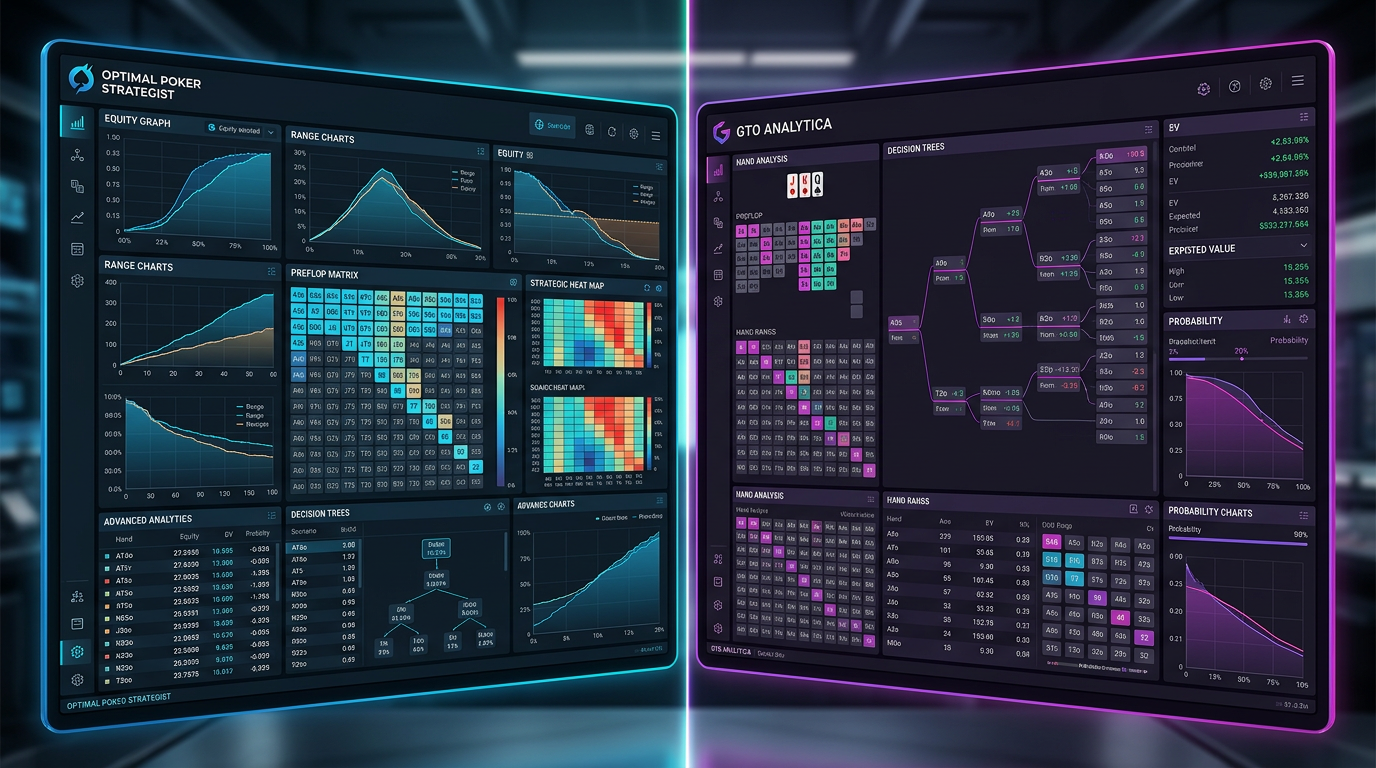
GTO Lab vs GTO Wizard 2026: A Real Head-To-Head After Using Both
I want to settle a question I get asked at least once a week: should I pay for GTO Lab or GTO Wizard?
Both products are pre-computed GTO solution libraries with a study interface. Both cost roughly the same depending on the tier you pick. Both are run by competent teams. Both have devoted user bases who'll argue passionately that their pick is correct. The reason this comparison is hard is that the products are similar in shape but different enough in detail that the right choice depends on who you are as a player.
I've used GTO Wizard from late 2022 through early 2025 (about 28 months as my primary solver). I switched to GTO Lab in March 2025 and I've been on it for 14 months. I have direct, recent experience with both. This article is the comparison I wish someone had written for me when I was making the decision in early 2025.
I'm Alex, 9 years online cash regular at NL200-500. I write reviews because I got sick of YouTube sponsorships pretending to be analysis. The links here are affiliate links — they pay me a commission at no extra cost to you, and they don't change what I'd say if they didn't exist.
Quick framing before we go deep. The headline answer to "which should you buy" is:
- GTO Wizard is the better all-around tool, has the better mobile experience, and is the right pick if you're a tournament player or a multi-game player.
- GTO Lab is the better cash-game-focused tool, has the better population deviation system, and is the right pick if you're a serious cash reg who wants exploit-focused training.
- Neither is the obviously correct universal answer. You should be picking based on your actual game and study habits.
Now let me show my work.
The Products At A Glance
| Attribute | GTO Lab | GTO Wizard |
|---|---|---|
| Type | Pre-computed solver workspace | Pre-computed solver workspace |
| Primary game focus | Cash | Cash + MTT + Spin |
| Solution library size | Large (cash-heavy) | Larger (broader game coverage) |
| Pricing range | $19-$99/mo | $49-$249/mo |
| Cheapest annual | $179 | $588 |
| Mobile experience | Bad | Good (iOS app + responsive web) |
| Population deviation | Yes, deep | Yes, lighter |
| Custom solving | Limited (Pro only) | Limited (Pro only) |
| MTT coverage | Limited (Pro only) | Strong across all tiers |
| Trainer adaptive weighting | Yes, weighted by your weaknesses | Yes, less granular |
| Hand history analyzer | Yes, fast | Yes, slightly slower |
| Free tier | No (trials only) | Yes, basic |
The pattern visible in this table: GTO Wizard covers more ground (more games, better mobile, a real free tier), while GTO Lab goes deeper in the specific area of cash + population work. They're tools optimized for different priorities.
Pricing Comparison In Detail
This is where the numbers actually matter. Both products have evolved their pricing in 2025-2026, so let me lay out the current state.
GTO Lab Pricing (2026)
| Plan | Monthly | Annual |
|---|---|---|
| Starter | $19 | $179 |
| Standard | $49 | $399 |
| Pro | $99 | $899 |
GTO Wizard Pricing (2026)
| Plan | Monthly | Annual |
|---|---|---|
| Free | $0 | $0 |
| Starter | $49 | $588 |
| Standard | $99 | $1,188 |
| Premium | $249 | (custom) |
The pricing models are different in interesting ways. GTO Lab has a true low-end paid tier (Starter at $19) but no free tier. GTO Wizard has a free tier with meaningful functionality, but no paid plan below $49/month.
Looking at the comparable middle tiers — GTO Lab Standard ($399/year) vs GTO Wizard Starter ($588/year) — GTO Lab is $189/year cheaper. If price is your tiebreaker, GTO Lab wins this round.
But the comparison isn't apples-to-apples because the tiers include different things. GTO Wizard Starter includes MTT solutions and mobile app access; GTO Lab Standard doesn't include MTT and has a poor mobile experience. Whether the GTO Lab Standard's lower price represents "better value" depends on whether you actually need MTT and mobile.
For a cash-only desktop-grinding player, the price gap is real value. For a tournament player or a mobile-heavy studier, the price gap is paying for things you don't need.
In CAD/AUD/NZD/GBP/EUR for the comparable tiers:
- GTO Lab Standard ($399/yr): ~$545 CAD / $610 AUD / $665 NZD / £315 GBP / €370 EUR
- GTO Wizard Starter ($588/yr): ~$800 CAD / $900 AUD / $980 NZD / £465 GBP / €545 EUR
For grinders outside the US, that's a meaningful absolute difference, particularly in CAD/AUD/NZD where the conversion is harshest.
Where GTO Wizard Wins
I want to be specific about where GTO Wizard is genuinely the better product, because this matters for the recommendation.
Mobile Experience Is Best-In-Class
GTO Wizard has a real iOS app (and the web is responsive enough to use on a phone or tablet). The app is fully featured: trainer mode, library browsing, range explorer, hand replayer. I can study on my phone during a commute and the experience doesn't feel compromised.
GTO Lab on mobile is bad. I covered this in my GTO Lab review — the range builder doesn't render properly on small screens and the trainer's combo selection requires precision tapping that doesn't work on touch. They've been promising mobile improvements for over a year and nothing has shipped.
For anyone who studies on the go — commuters, parents who study in 10-minute bursts, anyone who travels with only a phone — this difference is enormous. GTO Wizard wins this category by such a wide margin that it should drive the decision for mobile-heavy users on its own.
Tournament Coverage Is The Real Differentiator
GTO Wizard's tournament library is the deepest in the industry. ICM solutions, push-fold charts, MTT-specific situations, Spin & Go solutions — they cover ranges of stack depths and stack distributions you won't find elsewhere outside of dedicated MTT tools.
GTO Lab has tournament coverage on the Pro tier but it's secondary. The library is smaller, the ICM tooling is less developed, and the focus is clearly on cash.
If you play tournaments — whether that's daily MTTs, scheduled events, or Spins — GTO Wizard is the right pick by default. This isn't close.
The Free Tier Is Real
GTO Wizard's free tier gives you access to a basic library of common spots and limited use of the trainer. It's not enough for serious study but it's enough to evaluate the product, learn the interface, and reference standard spots. As a starting point for new players, this is significant.
GTO Lab has occasional 7-day trials but no free tier. New players have to pay to evaluate.
Browser Extension Integration
GTO Wizard has a browser extension that integrates with several poker site interfaces (where allowed) and can pull spots from your tracker for review. GTO Lab doesn't have an equivalent extension.
For my workflow this is minor — I do hand history review through the analyzer rather than through real-time integration. For some players, the in-game integration is genuinely useful.
Larger Coach And Content Ecosystem
GTO Wizard has been around longer and has a bigger coaching content ecosystem around it. Famous coaches use it on stream, produce content explaining its outputs, and have published companion materials. GTO Lab's content ecosystem is smaller.
This isn't a feature of the product itself, but if you learn well from following coaches who use the same tool you do, GTO Wizard has more options.
Where GTO Lab Wins
GTO Lab also has real strengths. Let me be specific about them.
Population Deviation Is Substantively Better
GTO Lab's Population Deviator is the single feature I'd point to that justifies subscribing to GTO Lab over GTO Wizard for cash players. The interface is purpose-built for exploring exploits. You take a GTO solution, lock the opponent's strategy to deviate from optimal in specific ways, and re-solve to see your exploitative response.
GTO Wizard supports node-locking but the workflow is clunkier. You can do similar exploration but the interface assumes you're a solver expert who knows exactly what to lock and how. GTO Lab assumes you're a developing exploit-aware player and gives you population templates, suggested deviations, and an interface designed for this specific use case.
For cash players whose study is about finding edges over the typical online player, this matters more than almost anything else in either product.
The Trainer Adapts To Your Weaknesses More Aggressively
Both products have a quiz/trainer mode. Both claim adaptive weighting. In practice, GTO Lab's trainer aggressively shows you spots in areas where you've been making mistakes, while GTO Wizard's trainer is closer to random sampling within a focus area you select.
The difference compounds. A month of GTO Lab trainer use has a noticeable effect on the specific leaks I've been working on. A month of GTO Wizard trainer use feels more like general practice without the same targeted improvement.
For a player with specific known weaknesses, GTO Lab's trainer is the better tool.
The Hand Analyzer Is Faster
Both tools have a hand history analyzer that takes a hand, parses it, and shows EV-by-node analysis. Both work fine. GTO Lab's analyzer is meaningfully faster — I can review 30 hands in an hour using GTO Lab vs about 18 hands in an hour using GTO Wizard. The interface design accounts for most of the difference; GTO Lab keeps the analysis on a single screen with less navigation.
For a player who reviews many hands per week, this speed adds up.
Cash Library Depth On Standard Tier
GTO Lab's Standard tier covers a deeper cash library at lower stakes (NL50-NL500 with multiple stack depths and sizing trees). GTO Wizard's Starter tier covers cash but the depth at the same price point is less. If you're cash-only, the comparison favors GTO Lab on a feature-per-dollar basis.
Lower Price For The Comparable Cash Tier
I covered this in the pricing section. $399/year vs $588/year for the comparable middle tier is a meaningful difference, especially over multi-year horizons. If you're a cash-only player, that $189/year delta buys other tools — a tracker upgrade, a Poker Academy subscription, InstaGTO for custom solving.
Head-To-Head On Specific Workflows
Let me run through the workflows that matter most and call which tool wins each.
Daily Drilling Routine
Both tools have trainer modes. For a 30-60 minute daily drill session targeted at improving specific spots:
- GTO Lab wins for cash players because the adaptive weighting is more aggressive and the spots feel more relevant.
- GTO Wizard wins for tournament players because the cash-specific weighting in GTO Lab doesn't help you with MTT spots.
Hand History Review After Sessions
Both tools have analyzers. For reviewing 10-30 hands after a session:
- GTO Lab wins on speed. Workflow is faster end-to-end.
- GTO Wizard wins on depth of analysis explanation. The text annotations in Wizard's analyzer are more developed.
For my workflow speed matters more, so I prefer GTO Lab. Your priority might differ.
Studying On Mobile
- GTO Wizard wins, no contest. The iOS app is real; GTO Lab's mobile experience isn't viable.
Population Exploit Exploration
- GTO Lab wins decisively. The Population Deviator is the better tool.
Tournament Study (MTT, Spin)
- GTO Wizard wins decisively. GTO Lab's MTT coverage is secondary.
Multi-Way Pot Analysis
Both tools have limited multi-way support. Neither is great. GTO Wizard slightly ahead because their coverage is broader, but for serious multi-way work you need PIO with custom trees.
Beginner Onboarding
- GTO Wizard wins because of the free tier and the more polished interface for new users. GTO Lab assumes you know what you're doing.
Coach-Quality Custom Solving
- Both lose to PIOSolver or InstaGTO. Neither is built for custom solver work as a primary use case.
Pricing Math Across Different Player Profiles
Let me show what your annual cost looks like across different player profiles.
Profile A: NL100 Cash Reg, Desktop-Only, US Player
- GTO Lab Standard: $399/year ✓ (recommended pick)
- GTO Wizard Starter: $588/year (overpaying for MTT and mobile you won't use)
Profile B: NL100 Cash Reg, Mobile-Heavy, Australian Player
- GTO Lab Standard: $399 USD ≈ $610 AUD/year (mobile experience hurts you)
- GTO Wizard Starter: $588 USD ≈ $900 AUD/year ✓ (recommended pick — you'll actually use the mobile)
Profile C: Daily MTT Player, Any Platform
- GTO Wizard Starter: $588/year ✓ (recommended pick — MTT coverage is the differentiator)
- GTO Lab Pro: $899/year (you'd need Pro for MTT, and even then coverage is thinner)
Profile D: Mixed Cash + Some MTTs, Desktop-Heavy
- GTO Lab Pro: $899/year ✓ (gets you the better cash tooling plus MTT)
- GTO Wizard Standard: $1,188/year (more comprehensive but you're paying ~$300/year extra)
Profile E: Beginner, Just Starting
- GTO Wizard Free: $0/year ✓ (start here, upgrade later)
- GTO Lab Standard: $399/year (premature spend before you know what you need)
Profile F: Coach Or Researcher
- Either + PIOSolver: ~$650-$1,500 for a complete stack
- Neither tool alone is sufficient — you need custom solving
What I Actually Use And Why
For full transparency: I switched from GTO Wizard to GTO Lab in March 2025 after about 28 months on Wizard. The reasons were specific.
I'm a cash-only player. I don't play tournaments. The MTT coverage that's a major part of GTO Wizard's value proposition was, for me, paying for capability I never used. I was on Wizard's Standard plan at $99/month for the deeper library access.
The triggering event for the switch was a population deviation analysis I was trying to run. I had a specific hypothesis about how players in my pool were under-defending the BB against late-position opens with small sizings. In Wizard, exploring this hypothesis was technically possible but required manual node-locking that took 20-30 minutes per scenario. I tried GTO Lab's free trial that week, ran the same analysis in their Population Deviator in 5 minutes, and saw the exploit clearly.
That was the moment. I downgraded my Wizard subscription, paid for GTO Lab Standard, and committed to a 90-day evaluation. After 90 days I cancelled Wizard entirely. I've been on GTO Lab Standard since.
If I were a tournament player I'd still be on GTO Wizard. If I traveled more and needed mobile study, I'd still be on Wizard. If I were a beginner I'd start with the Wizard free tier. The choice is genuinely contextual.
Common Questions I Get About This Comparison
Can you use both at the same time? Yes, but it's not cost-effective for most players. If your study budget allows ~$1,000/year on solver subscriptions, you could run both. For most players that's overkill — pick one, use it well, supplement with InstaGTO or PokerSnowie for capabilities the primary tool lacks.
Will switching cost you study progress? You'll lose your saved drill sets, your custom focus areas, and your tagged spots. The conceptual learning carries over. Allocate a weekend to rebuilding your saved configurations in the new tool.
How often do they update their libraries? Both tools push library updates roughly monthly. New games, new stack depths, additional sizings. Both teams are active.
Which is better for PLO? Neither is the right answer for serious PLO work. GTO Wizard has some PLO content; GTO Lab has minimal. For PLO, look at PLO Genius or other PLO-specific tools.
Does either work in countries where poker is legally restricted? Both work as study tools regardless of where you play. They're not connected to poker sites in real time. Whether you can play poker is a separate question from whether you can study with these tools.
Can you share an account? No. Both tools enforce single-user accounts and ban for sharing. Don't bother.
Will GTO Wizard cut prices to match GTO Lab? Maybe. GTO Lab has been pricing aggressively and there's competitive pressure. Pricing across both products has been adjusting. Lock in annual pricing if you find a deal you like.
Is the math actually different between the two? No. Both compute the same kind of equilibrium solutions on the same kind of trees. Differences in specific spot recommendations are due to different tree configurations (sizings, stacks) more than to differences in solver quality.
What about the trainer's chess-engine-style ratings? GTO Wizard has implemented a chess-style rating for trainer performance. GTO Lab has its own scoring system but doesn't market it the same way. Both work; the marketing is different.
Should you wait for either to add a feature you need? Probably not. Both teams ship features at predictable but not rapid cadences. If you need something now, buy what works now.
Verdict: It Depends, And That's An Honest Answer
I want to resist giving you a single answer because the comparison is genuinely contextual. Here's my breakdown:
Pick GTO Lab if: you're a cash player at NL100+, you study on desktop, you want the deeper population deviation tooling, and you don't play tournaments. The Standard plan at $399/year is the right tier. This is the right pick for me and for most of the cash regs I know.
Pick GTO Wizard if: you play tournaments at any level, you want a real mobile experience, you're a beginner who wants a free tier to evaluate, or you value the broader content ecosystem around the tool. Their Starter plan at $588/year is the right entry point. This was the right pick for me when I was playing some MTTs in 2023.
Pick neither (or pick both) if: you're a coach, a researcher, or a player who hits the limits of pre-computed libraries regularly. Both tools have ceilings for custom work; you'll need InstaGTO or PIOSolver in addition.
Pick the GTO Wizard free tier if: you're brand new to GTO study and don't yet know what you'll want from a paid tool. Use the free tier for 60-90 days, identify what you wish it did better, and let that inform your paid pick.
The worst decision you can make here is to pay for either tool and not use it consistently. Both products require active study to deliver value. Neither will improve your win rate by being installed on your computer. Pick the one that fits your study habits, commit to a workflow, and put in the hours.
If forced to give one answer for the median reader of this article: a cash-focused player at NL50+ in Canada, Australia, New Zealand, the UK, or Ireland should subscribe to GTO Lab Standard and supplement with InstaGTO when custom solves are needed. The total annual cost lands around $689 USD, which is the most efficient stack I've found for serious cash study without enterprise-grade tooling like PIOSolver. That's the recommendation I give friends and it's the recommendation I'd give you.
A Week In My Routine On GTO Lab (And What It Looked Like On Wizard)
Let me give you a side-by-side of what daily use actually looks like, because this matters more than feature lists.
Current routine on GTO Lab:
Monday morning is heavy study. I open GTO Lab, go to the trainer, and run a 45-minute drill weighted toward whatever leak I identified in the previous week's hand review. The trainer's adaptive weighting puts me in spots I'm bad at, which is uncomfortable but right. After the trainer I switch to the Population Deviator and explore one specific exploit hypothesis for 30 minutes. By 11 AM I'm done with GTO Lab for the day.
Tuesday and Thursday are lighter. 25-30 minutes each, focused trainer work on a single spot family. I also fire up the analyzer and review 6-10 hands flagged from Sunday's session.
Wednesday is hand review day. I spend most of the morning in HM3 marking hands, then transfer the worst spots into GTO Lab's analyzer for solver review. The analyzer is fast — I can get through 12-15 hands in 90 minutes, including thinking about each one.
Friday is variety. Some weeks it's range work in the range explorer. Some weeks it's exploring a new spot family I want to learn. Some weeks it's revisiting old leaks to verify I've actually fixed them.
When I was on GTO Wizard the routine was structurally similar but the experience was different in two specific ways. First, the trainer felt less targeted — I'd select a focus area but the spots felt more random within that area, and the sense of "I'm working on my exact weakness" wasn't as strong. Second, the analyzer was slower per-hand, which meant Wednesday's hand review session covered 6-8 hands instead of 12-15. Over a year that's a real difference in coverage.
Total weekly time in primary solver: about 4-5 hours, roughly the same on either tool. The throughput per hour is what shifted.
The Spots Where I Most Notice The Difference
I want to be specific about where the two tools feel different in practice.
Population deviation work. Night and day. GTO Lab's Deviator is purpose-built; Wizard's node-locking is general-purpose. When I want to ask "what if Villain over-folds turns by 12% in this node," GTO Lab gives me that answer in 5 minutes. Wizard makes me build the deviation manually, which takes 20-30 minutes per scenario. For a player whose study is exploit-focused, this single workflow gap is the largest practical difference between the products.
Adaptive trainer drilling. GTO Lab's weighting feels more aggressive. I'll get the same kind of spot — say, BB defense vs CO opens with backdoor flush draws — repeatedly until my accuracy passes a threshold, then the focus shifts. Wizard does this too but the cycling between focus areas felt looser. After a month on each tool I had a clearer sense of "I've improved at X" on GTO Lab.
Hand history analyzer throughput. GTO Lab edges Wizard on speed. The interface keeps the analysis on one screen with less navigation. For someone who reviews many hands per week, the time savings compound.
Mobile spot reference. Wizard wins decisively. If I'm waiting somewhere with my phone and want to quickly pull up the GTO solution to a spot I just thought about, Wizard's app handles it. GTO Lab on a phone is unusable.
Tournament study. Wizard wins decisively. If I were playing MTTs I'd be on Wizard. GTO Lab's MTT coverage is technically present but the depth and the tooling are clearly secondary.
Beginner exploration. Wizard wins because of the free tier. A new player can poke around without committing money. GTO Lab forces the paid commitment.
These are the dimensions that have actually shifted my opinion over time. Feature-list comparisons miss that the differences in daily use are concentrated in a few specific workflows.
What I'd Tell Someone Choosing Between These For The First Time
Practical gotchas not on either marketing page.
Don't pick based on which YouTuber you watch. Most of the famous coaches have sponsorship deals with one product or the other. Their tool choice reflects their business relationship as much as the product's quality. Pick based on your game and your study habits.
Don't subscribe to both at the same time. I see players do this thinking they'll get the best of both worlds. In practice you'll use one as your primary and the other will sit unused, costing you money. Pick one, commit, supplement with InstaGTO if you need custom solving.
Try both free tiers/trials first. GTO Wizard's free tier is real and useful. GTO Lab runs 7-day trials periodically — wait for one if you're not in a hurry. Twenty hours in each will tell you which interface fits how you think.
The trainer is where most of the value is. Both products have analyzer modes, library browsers, range explorers. The trainer is the daily-use feature. Evaluate the trainer harder than the other features when you're trialing.
Don't pay annually until you've used the tool for 2-3 months. Annual pricing is meaningfully cheaper but the lock-in is real. Pay monthly first. Switch to annual after you're confident you'll use it for a year.
Set a renewal calendar reminder. Both products auto-renew. If you stop using the tool, you should know before the next charge hits. A simple calendar event 7 days before renewal saves you from $400-$1,200 of unused subscription.
The product you switch to second always feels worse for the first two weeks. Adjustment cost is real. Don't conclude "the new tool is bad" until you've spent 30 days with it. The first impression after switching is unreliable.
Detailed Configuration Walkthrough For Each
The first-week setup matters because both tools require some configuration to be useful. Here's what I'd actually set up.
GTO Lab first-week setup:
- Set your preferred bet sizing schemes in user preferences (e.g., 33%/75%/overbet for SRP, separate sizings for 3-bet pots).
- Pin the cash spot families you study most to your dashboard for one-click access.
- Build 5-8 saved filters in the analyzer for your most common review patterns (3bp_OOP_river, SRP_turn_check_raise, etc.).
- In the trainer, configure a "focus area" for each weak spot you want to target. The trainer uses these to weight your sessions.
- Bookmark 10-15 reference solutions you find yourself looking up repeatedly. Faster than re-navigating each time.
That's about 3 hours of setup work and it pays off forever after.
GTO Wizard first-week setup:
- Install the iOS app and sign in. Test that it syncs.
- Configure your preferred bet sizings in preferences (similar to GTO Lab).
- Pin your most-studied games (cash, MTT, Spin) to your home screen.
- Set up the trainer's focus areas for the leaks you want to address.
- Install the browser extension if you use a tracker that integrates with it.
- Bookmark reference solutions for quick recall.
Roughly the same 2-3 hours of setup. The mobile sync setup is the one extra step Wizard requires.
How These Fit Into A Broader Study Stack
Neither tool is sufficient on its own for a serious study workflow. The full stack I'd recommend looks like this:
| Layer | GTO Lab path | GTO Wizard path |
|---|---|---|
| Primary solver workspace | GTO Lab Standard | GTO Wizard Starter |
| Custom solving | InstaGTO Standard | InstaGTO Standard |
| Pattern practice | PokerSnowie Pro (optional) | PokerSnowie Pro (optional) |
| Hand database | HM3 or PT4 | HM3 or PT4 |
| Video coaching | Poker Academy (optional) | Poker Academy (optional) |
The structure is the same regardless of which solver you pick. The solver is your truth source and study workspace; the tracker is your data; the custom solver fills gaps; the AI provides daily reps; the video content provides framing.
The mistake I see is players treating their pre-computed solver as a complete study solution. It isn't. You need the tracker to identify what to study. You need the custom solver for spots outside the library. You need the AI for the rep cadence the solver alone doesn't provide. The solver alone is necessary but not sufficient.
After 14 Months On GTO Lab: Honest Assessment
I'll keep my GTO Lab Standard subscription through 2026 and probably beyond. The Population Deviator is the feature I use most heavily and nothing matches it elsewhere. The trainer's adaptive weighting has measurably improved specific weaknesses I targeted. The price relative to capability is fair.
My honest satisfaction is 8/10. The product is strong. The mobile experience is the one chronic disappointment — not viable on a phone, frustrating to study from a tablet during travel. The MTT secondary status doesn't affect me but would affect a tournament player materially. The lack of a free tier means I can't recommend GTO Lab as a starting point for total beginners.
Looking back at GTO Wizard, the 28 months I spent there were also satisfying. If my game profile changed — if I started playing tournaments, or traveled more and needed mobile-first study — I'd switch back without hesitation. The reason I left wasn't that Wizard was bad; it was that GTO Lab fit my specific cash-focused desktop-heavy workflow better.
The honest answer to "which should you pick" is the same one I gave at the top: it depends. Both are good products. Pick the one that matches your game profile and commit to using it. The hours you put in matter more than the tool you choose.