GTO Solver for Beginners: A Real Guide to Actually Using One
GTO solvers confuse most beginners. Here's what a solver actually does, when to use one, and a six-week study plan that produces real results.
GTO Solver for Beginners: A Real Guide to Actually Using One
A contrarian claim to start: most poker players who buy a GTO solver are wasting their money. Not because solvers don't work — they're the most powerful study tool ever invented for poker — but because most beginners use them like they'd use a cookbook. They look up "the right play" in a specific spot, memorize it, and then misapply it the next time they see a slightly different board. They study a thousand spots and learn nothing transferable.
The players who get real value from solvers treat them like a microscope, not a recipe. They use them to develop intuition for the underlying logic of poker — why certain ranges play certain ways on certain boards. They study fewer spots, more deeply, and the lessons compound across thousands of similar situations they'll see at the table.
This guide is going to teach you the second approach. I'll explain what a solver actually is in language that doesn't assume a math degree. I'll walk you through what to do in your first week with one, your first month, and your first six months. I'll tell you which solver to start with based on your stake, your budget, and how much time you can realistically commit. And I'll be honest about the things solvers can't do — because the gap between what people think solvers do and what they actually do is the source of most beginner mistakes.
I've been studying with solvers since 2018. I started with PioSolver back when running a sim took 45 minutes per board. I've used GTO+, MonkerSolver, and most of the modern browser-based options. I currently run GTO Lab for daily study and GTO Wizard's premium tier for spot-checks. I play NL200 cash 6-max as my primary game. The advice in this guide is what I would give my younger self if I could go back to 2018 and avoid the four years of bad solver habits I built up.
What a Solver Actually Does (Without the Math)
Forget the equations. A solver is a piece of software that takes three inputs:
- A starting situation (positions, stack sizes, who acts first)
- The hand ranges each player is playing with
- The bet sizes that are allowed at each decision point
And it produces one output: the unexploitable strategy for both players. "Unexploitable" means a strategy that nobody can profit from by adjusting against it. If both players use the unexploitable strategy, neither can win money from the other (in the long run, ignoring rake).
That's it. That's what a solver does.
Notice what it doesn't do. It doesn't tell you what your opponent is doing. It doesn't tell you what to do against a specific opponent. It doesn't tell you "the best play" — it tells you the unexploitable play. Those are different things, and the difference is where most beginners get lost.
Here's a concrete example. You're in the BB facing a BTN open at 100bb. The solver tells you that the unexploitable defense range is some specific set of hands, with some specific 3-bet frequencies. If your opponent opens 50% of hands but never folds to 3-bets, the unexploitable strategy is wrong — you should 3-bet way less and value-bet flop more. If your opponent opens 20% and folds to 3-bets 75% of the time, you should 3-bet way more.
The solver is a baseline. Real money comes from deviating from the baseline based on what your opponents actually do. Beginners who treat the solver as gospel actually play worse than beginners who trust their instincts, because they're applying the wrong strategy in nearly every spot they're in.
This is the most important thing to understand before you spend a dollar on a solver. The solver tells you the unexploitable strategy. Your job is to learn from it, not to copy it.
When You're Actually Ready for a Solver
I see this question constantly: "I just started studying poker, should I get a solver?" The answer is almost always no. Here's the readiness checklist I use.
You can recall preflop ranges from memory for every position. Not "look them up on a chart" — recall. UTG opens what? CO opens what? BTN opens what? What does SB do facing a CO open? What hands cold-call vs. 3-bet? If you have to think about any of these, you're not ready.
You understand basic equity calculations. What's AKs vs JJ preflop? What about on a Q72 flop? What about K72? You don't need exact numbers — you need the intuition for whether a hand is favored, slightly behind, or crushed.
You can articulate why bets work. Why does a small cbet on K72 make sense as the preflop raiser? Why is a big cbet on T98 questionable? If you can't reason through these without help, the solver outputs will be opaque.
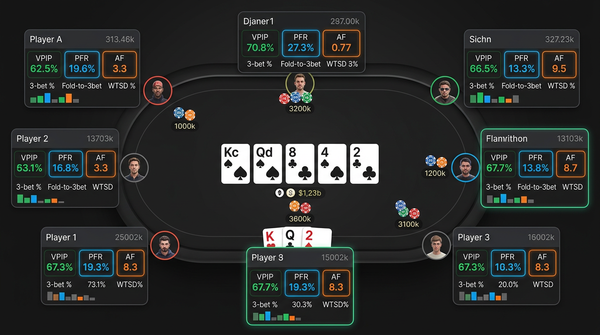
You have a database with your own hands. Without your own hand history, you'll study generic spots that have no connection to the leaks in your actual play. Get a HUD running first — PokerTracker 4 or Hold'em Manager 3 at $99 one-time is the right starting point.
You play at least 5,000 hands a month. If you play 500 hands a month, you don't have enough volume to validate what you're learning. The solver studies you do won't transfer because you don't see the same spots often enough.
If any of these are missing, fix them first. A solver compounds existing knowledge — it doesn't create knowledge from scratch. Beginners who skip these prerequisites end up confused and quit study altogether.
The First Solver: What to Buy
Assuming you're ready, what should you actually buy? In 2026, the realistic options are:
GTO Lab at ~$49/month or $399/year. This is what I recommend for most low-stakes regulars. The interface is the most beginner-friendly of the modern solvers. Pre-solved spot library is comprehensive for cash games. The educational content is genuinely useful (most "tutorial" content from solver companies is generic — GTO Lab's is actually targeted to common spots). Trial available.
GTO Wizard at $49–$99/month depending on tier. The premium tier is the gold standard for serious study. Pre-solved trees cover more formats (cash, MTT, spin & gos, heads-up). Trainer mode is the best in the business. More expensive than GTO Lab. If you play multiple formats or higher stakes, justify the cost.
InstaGTO at ~$29/month. Cheaper option. Solid for cash games at 100bb. Less coverage than GTO Lab or GTO Wizard. Good budget choice for someone who only plays cash and doesn't need the breadth.
PokerSnowie at $29/month. Not really a solver — it's a neural network that approximates GTO play. The interface is the most beginner-friendly of all options. Doesn't let you customize spots or run sims. Good for beginners who are still building base intuition; outgrown within 3–6 months.
Open-source solvers (TexasSolver, etc.) — free. Steep learning curve. You build trees yourself, which means you have to know what's reasonable. Skip for now unless you're a software engineer who wants to tinker.
PioSolver, Simple Postflop — these are the OG desktop solvers from before the browser-based wave. Still excellent. More expensive ($200+ one-time) and require more horsepower from your machine. For most beginners, the browser-based options are a better entry point.
My recommendation: start with GTO Lab's trial. If the interface clicks for you and the pre-solved coverage matches your game, commit to it. If you want broader format coverage and you can afford it, GTO Wizard. If money is genuinely tight, InstaGTO does the job for cash games at lower cost.
What a Solver Output Actually Looks Like
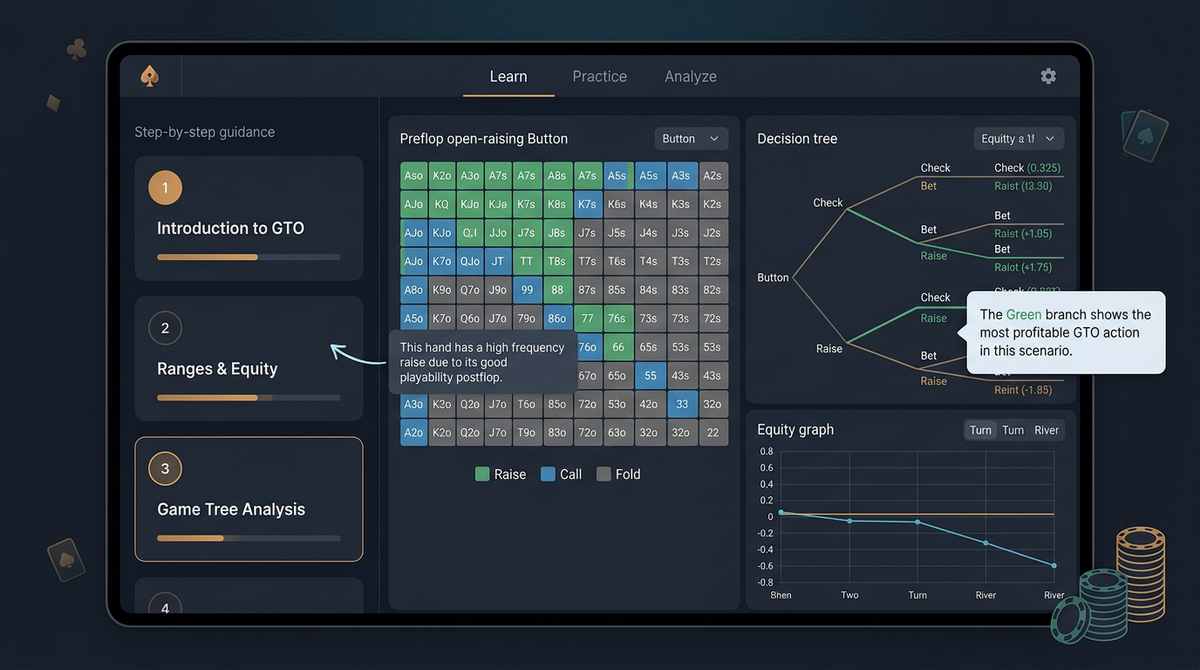
When you load a solved spot, you'll see something like this:
- A range matrix showing all 169 hand combinations, color-coded by frequency
- Bet sizing options at the current decision point, with EV numbers
- Frequencies for each action (e.g., "bet 33% pot 60%, check 40%")
- A tree showing the rest of the game beyond this decision
If this looks like alphabet soup, that's normal. The first time I opened a solver output I stared at it for ten minutes and gave up. Here's how to actually read it.
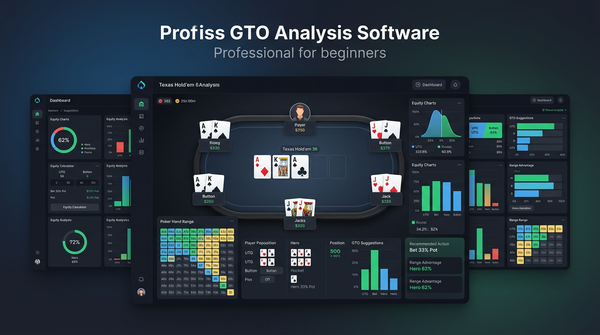
Start with the range matrix. This is the 13×13 grid of starting hands. Each cell shows what the solver does with that specific hand at this decision point. The colors mean:
- Green / dark green: bet (often with size labels)
- Red / orange: check or call
- Gray / no color: not in range here
- Mixed colors: the solver does multiple things with this hand at different frequencies
The first thing to look at is the structure of the betting range. Is it polarized (premium hands and bluffs)? Is it merged (medium-strong value, no real bluffs)? Is it linear (top of range only)? The structure tells you the strategic logic of the spot.
Then look at frequencies. "Cbet 60% bet 33% pot, check 40%" is a different spot from "Cbet 90% bet 50% pot, check 10%." The frequency tells you how often the solver bets at all. If it's high (80%+), you can simplify your strategy by always betting. If it's mixed (50–60%), the spot is more nuanced.
Then look at sizing distribution. If the solver uses multiple sizings, it's telling you that different parts of your range want different sizes. This is where things get complicated and where beginners overcomplicate. In low-stakes games, you can often simplify to a single sizing without losing meaningful EV.
Finally, look at downstream EV. The numbers in the tree tell you how much each action is worth. The EV difference between options is more important than the absolute numbers. If betting and checking are within 0.1bb of each other, both are fine. If betting is 2bb better than checking, it's clearly the right play.
Spend your first week just learning to read these outputs. Don't try to memorize anything. Just look, click around, get comfortable.
Your First Week: Just Look at Stuff
Here's the trap I want you to avoid: spending your first week building trees, running custom sims, and trying to "study." You'll fail because you don't yet have the framework to know what you're looking at.
Instead, your first week should be pure exploration. Open the solver. Look at any spot. Click around. Notice patterns. Don't try to learn anything specific.
Some specific exploration prompts:
Day 1: Look at preflop ranges. UTG vs CO vs BTN — how do RFI ranges differ? How do 3-bet ranges differ by position? What does cold-calling look like? Just absorb the structure.
Day 2: Pick a single board texture (K72 rainbow) and look at how the BTN cbets vs how the UTG cbets in single-raised pots. Same board, different positions — notice the difference in frequency and sizing.
Day 3: Pick a different board (T98 two-tone). Same exercise. How does the cbet logic change on a wet board vs a dry one?
Day 4: Look at 3-bet pots. What does the cbet look like as the 3-bettor on different boards? How does it compare to single-raised pot cbet logic?
Day 5: Pick one specific hand (e.g., AKo) and trace its play through several spots. When does AKo cbet flop? Bet turn? Bet river? How does it play vs a check-raise?
Day 6: Look at BB defense vs BTN open. What hands fold? What hands call? What hands 3-bet? What's the structure of the 3-bet range?
Day 7: Review what surprised you this week. Write down three things you didn't expect. Those are your starting points for deeper study.
By the end of week one, you should have a vague but honest sense of what the solver shows you. You won't have memorized anything. You won't have "learned strategy." You'll have built familiarity, which is the prerequisite for everything else.
Weeks 2–4: Pick One Leak and Drill
Now you have your own database (you set up a HUD before you bought the solver, right?). Pull your stats. Find your worst leak. Make it the focus of weeks 2–4.
A "leak" in this context means a stat or pattern in your play that's clearly off baseline. Common ones:
- BB defense too tight (folding to BTN opens >65%)
- 3-bet frequency too low (3-bet <5% from any position)
- Cbet flop too high or too low (deviates 15%+ from solver in similar spots)
- Fold to 3-bet too high (>80% from any opening position)
- Check-raise frequency basically zero
Pick the one with the biggest gap between you and the solver. That's your three-week project.
For each session in weeks 2–4:
- Open the solver to a spot related to your leak. (Example: if your leak is BB defense, look at BB vs BTN open.)
- Spend 20 minutes exploring that spot and adjacent spots.
- Play your normal session.
- After playing, identify any hands where this leak came up. Were you playing closer to the solver? Or did you default to your old habit?
- Note one specific thing you learned.
Three weeks of this is enough to meaningfully shift one stat. You won't fix the leak entirely — that takes months — but you'll see measurable movement in your database.
The trap to avoid: trying to fix five leaks at once. You can't. Pick one. Get it 70% fixed. Move on.
Months 2–6: Building a Study System
By month two, you should have a workflow that looks something like this.
Daily (15–30 min): Trainer mode in your solver. Drill spots, get scored. This is rep work — building intuition through volume.
Weekly (60–90 min): Pick the worst leak in your current play (rotate as you fix old ones). Spend the session deep-diving on solver outputs related to that leak.
Weekly (30 min): Hand history review. Pull 3–5 hands from your last week of play that you weren't sure about. Run them through the solver. Compare what you did to what the solver does.
Monthly (60 min): Big-picture review. What stats moved this month? What didn't? What's the next leak to target?
This adds up to maybe 4–5 hours of study per week. It's sustainable. It produces measurable improvement. It's also less than most people think a "serious" study schedule requires — but quality of study matters way more than quantity.
The mistake I see is players who burn out on 2-hour daily solver sessions for two weeks, then study nothing for a month. Consistency beats intensity. 30 minutes a day for six months will outperform a 30-hour weekend bootcamp every time.
What Solvers Cannot Teach You
Honest about limitations.
Exploitative play. Solvers compute the unexploitable strategy. Real-money games are full of exploitable opponents. The biggest edge in poker comes from deviating from GTO based on opponent tendencies — and solvers can't teach you to do that. They can teach you the baseline; you have to learn deviation through opponent reads.
Game flow and table dynamics. A solver doesn't know that the guy in seat 4 just lost three buy-ins and is on tilt. It doesn't know that the table average VPIP just shifted because two nits left. These are real factors that affect your decisions and require human judgment.
Live tells. Obviously. If you play live, the solver is one input among many.
Variance management. A solver tells you the highest-EV play. Sometimes the highest-EV play has terrible variance and you should take a slightly lower-EV play with less variance, especially in tournaments under ICM pressure. Solvers don't reason about your bankroll.
Multi-way pots. Most solvers handle heads-up situations only. Multi-way pot solving is computationally much harder and the available solutions are less reliable. Don't expect a solver to give you definitive answers in 4-way pots.
Long-term study habits. A solver will not make you a better player by itself. It's a tool that compounds existing study habits. If you don't have a study system, the solver will sit unused.
Quick Reference Tables
| Solver | Price (2026) | Best for | Skill ceiling |
|---|---|---|---|
| GTO Lab | ~$49/mo, $399/yr | Cash game regs, beginner-friendly | High |
| GTO Wizard | $49–$99/mo | Multi-format players, advanced | Very high |
| InstaGTO | ~$29/mo | Budget cash players | Medium-high |
| PokerSnowie | $29/mo | Pure beginners building intuition | Medium |
| TexasSolver (open source) | Free | Engineers tinkering | Very high but steep curve |
| Prerequisite for solver study | How to verify |
|---|---|
| Preflop ranges memorized | Quiz yourself: UTG/MP/CO/BTN/SB/BB |
| Equity intuition | Use Equilab on 30+ spots |
| Verbal reasoning about bets | Explain your last 10 cbets in writing |
| Own hand history database | HUD installed, 50,000+ hands |
| Sufficient volume | 5,000+ hands per month |
| Study time per week | Realistic outcome |
|---|---|
| < 1 hour | Negligible improvement |
| 2–3 hours | Modest improvement, slow leak fixes |
| 4–6 hours | Measurable improvement in 4–6 weeks |
| 8+ hours | Diminishing returns vs play time |
A Six-Week Plan You Can Actually Follow
Here's a concrete six-week plan that I've given to several coaching students with consistent results.
Week 1: Familiarization. No goals. Just open your solver every day and click around. Read range matrices. Look at common spots. Watch one tutorial video. The only outcome is "I'm comfortable opening this software."
Week 2: Preflop validation. Pull a published preflop chart system. Compare it to your solver's preflop solutions. Where do they agree? Where do they differ? Why? You'll discover that no two charts agree exactly, and you'll start building judgment about what trade-offs each chart makes.
Week 3: Single-board cbet study. Pick five common flops (K72r, T98tt, AT4r, J52r, 887r). For each, look at BTN cbet vs BB in single-raised pot. Identify the structural pattern: which boards get high-frequency small cbets, which get mixed strategies, which get checks more often. Write a one-paragraph summary of what you learned.
Week 4: Your specific leak. Pull your database. Find your worst stat. Spend the week studying solver outputs related to that stat. Make it your only focus.
Week 5: 3-bet pots. Most beginners under-study 3-bet pot postflop play. This week, look at common 3-bet pot spots. As the 3-bettor, what does cbet look like? As the caller, what does defense look like?
Week 6: Hand history dive. Pull 10 hands from your recent play. For each, run the spot through the solver. Compare what you did to what the solver does. Note where you were on, where you were off, and what you'd do differently. This is the most valuable single exercise in solver study and the one most beginners skip.
Six weeks. Five hours a week. About 30 hours total. If you do this consistently, you'll know more about how to use a solver than 90% of low-stakes regs, and you'll have the foundation to keep improving for years.
Things I Wish I'd Known in 2018
A few hard-won lessons I'll save you from learning the slow way.
Don't try to memorize solver outputs. You can't. There are too many spots, too many board textures, too many variables. What you can do is internalize patterns — the logic of why certain ranges play certain ways. Pattern recognition transfers; memorization doesn't.
Simplify aggressively. The solver might use four sizings on a turn. You don't need to. In a real game with real opponents, picking one or two sizings and using them well will outperform mixing four sizings poorly. Most pros simplify; the solver is the upper bound, not the recipe.
Solver answers are population-dependent. The "right" cbet frequency depends on what villain's range is. Solver gives you the answer assuming villain plays optimally. In a low-stakes game where villain plays badly, the right answer is different. Always ask: who am I actually playing against?
Time spent on the table beats time in the solver. Past a certain point, you improve by playing more and studying less, not the other way around. If you're studying 10 hours a week and playing 5, you have it backwards.
Don't confuse solver familiarity with poker skill. Plenty of guys can navigate solvers fluently and still lose money at low stakes. The solver is a tool for improvement, not a substitute for the judgment and discipline that produce winning poker.
The Verdict
If you're a beginner who's done the prerequisite work — memorized preflop ranges, built equity intuition, tracked your own play, and accumulated some volume — then yes, a solver is the next investment to make. GTO Lab at $49/month is where I'd start. The trial will tell you in a week whether the interface fits how you think.
But I want to be direct: a solver is not magic. It's a microscope, and microscopes are useless to people who don't know what they're looking for. The players who get the most out of solvers are the ones who came in with a study system already in place and used the solver to make that system more effective. The players who get the least are the ones who bought a solver hoping it would replace the missing study system. Don't be the second kind.
Start by setting up your HUD. Track 50,000 hands. Identify your top three leaks. Then buy a solver and use it specifically to fix those leaks. Six months from now, your stats will tell the story — your fold-to-3bet will be closer to baseline, your cbet frequencies will look more reasonable, your overall winrate will tick up.
The solver itself is the easy part. The discipline to use it consistently for years is the hard part. Start with the easy part this week. Decide whether you're going to do the hard part next.
How a Solver Fits Into a Broader Study Stack
A solver in isolation produces less improvement than people expect. Wired into a real study system, it produces more. Here's how mine connects.
The bottom layer is play. I'm putting in 20–30 hours a week of actual sessions. No amount of solver work substitutes for this. The solver is upstream of play in some sense and downstream in another — it informs what I do at the table, but the table is where solver knowledge gets stress-tested and absorbed.
The next layer is the database. PT4 captures every hand, tags sessions, lets me filter for any pattern I want to study. Without the database, I can't identify which spots from my actual play are worth running through the solver. The hand history is the input list for solver study.
Above the database sits the solver. GTO Lab is my daily driver. I use it for two purposes: drilling spots in trainer mode (rep work, building intuition) and looking up solutions to specific hands from my own play (targeted leak fixing). These are different use cases with different time budgets.
Sitting alongside the solver is a notebook. Literal paper, not software. I write down patterns I notice, questions I want to investigate, things I learned that surprised me. The notebook is what consolidates solver work into transferable knowledge. Without it, I'd run hundreds of sims and remember none of them.
The whole system runs on a weekly cycle: identify a leak from the database, study related spots in the solver, write down what I learned, take it to the table the next session, see how the new approach plays out, refine in the next cycle.
Take any layer out and the system breaks. Solver alone produces a player who can talk about GTO but can't beat the games. Database alone produces a player who knows their leaks but can't fix them. Play alone produces a player who's logged hours but isn't improving.
A Real Week of Solver Study
Concrete schedule, not idealized.
Monday morning, 30 min. Open GTO Lab trainer mode. Drill the spot category I'm working on this week (rotating: BB defense, 3-bet pots IP, single-raised pot turn play, etc.). Get a score. Note any patterns of mistakes.
Tuesday, no solver. Play a normal session. Pay extra attention to spots related to this week's focus.
Wednesday evening, 60 min. Pull 5 hands from the past two days that touched my focus area. Run each through the solver. For each, write down: what I did, what the solver does, why the solver does that, what I'll do next time.
Thursday, no solver. Play.
Friday morning, 30 min. Trainer again. See if the score moved from Monday. Sometimes it does, sometimes it doesn't — both are data.
Friday evening, 30 min. Pull the worst-played hand of the week according to my own judgment. Deep-dive on the solver. Try to articulate what I missed in real time.
Saturday and Sunday play sessions, no solver work. Brain consolidation.
Total weekly solver time: about 2.5 hours. Less than people think a "serious" solver routine looks like. More than most people actually do consistently. Consistency is the only thing that matters.
The Spots I Study Most as a Cash Game Reg
If you only have a month with a solver and you want to maximize your winrate at low-stakes 6-max cash, study these specific spots. They come up constantly and most regs are still misplaying them.
BB defense versus a single BTN open at 100bb. The most common preflop spot in 6-max. Solver defends a wider range than feels comfortable, especially with low suited connectors and small pairs. Drill until the wide defense range feels normal. This single adjustment alone moves your winrate.
SRP cbet on dry low boards (K72r, A83r, K53r) as the BTN versus the BB. Tiny cbet at high frequency. Most regs cbet too big or check too often. Get this right and you're printing on a class of boards that comes up multiple times per session.
3-bet pot cbet on Axx and Kxx boards as the 3-bettor IP. Big cbet, very high frequency. The solver almost never checks here. Beginners check too much because they're scared of getting raised. The solver isn't.
Turn play after villain check-calls flop and you fire turn. This is where most river decisions get set up. The solver's turn bet sizing distribution is different from what most regs use. Worth a deep dive on a single board texture and getting the sizing pattern right.
River play out of position after villain has checked back two streets. The solver's "delayed bluff" frequency surprises most beginners. There are spots where you should bluff river OOP after villain checked back flop and turn, even though it feels like betting into showdown.
BB defense versus a 3-bet from any open. Most beginners flat too wide and 4-bet too narrow. Drill the cold-call vs 4-bet vs fold splits.
SB versus BTN open. The squeeze versus flat versus fold split here is where a lot of EV gets bled by beginners.
Eight specific spot families. Probably 40 hours total to get genuinely comfortable with all of them on the trainer. The carryover to your actual play is larger than studying anything more general.
Configuration Tips for Getting More Out of Your Solver
Specific small things that compound over time.
Always study from your own hand database, not generic spots. Open the solver. Open your database. Pick a hand from your last session. Study that exact spot. The transfer from solver work to in-game decisions is dramatically higher when you're studying spots you actually saw.
Simplify sizings before you study them. If the solver uses four sizings on a turn, ignore three of them. Pick the most-used one. Real opponents don't recognize four sizings as distinct strategies, so you don't lose much by simplifying. The complexity-to-EV ratio of multi-sizing strategies at low stakes is terrible.
Lock opponent ranges to match what you actually face. Most modern solvers let you adjust villain's range. If you're playing against players who flat too wide, lock the BB calling range wider and see how your strategy should change. This is where solver work gets exploitative.
Study positional asymmetry. Look at the same spot from both sides. BB vs BTN is a different spot from BTN vs BB. Most beginners only study from one perspective and miss half the picture.
Use the EV difference, not the absolute number. "Bet has EV 8.2, check has EV 8.0" — both are basically fine. "Bet has EV 8.2, check has EV 6.4" — bet is clearly correct. Train yourself to look at the difference, not the raw number.
Build a personal spot library. Save the spots you've studied to a folder or doc with notes. Over time you build a personal reference of "what does the solver do in this exact spot." Faster to look up than re-deriving.
Six Months Later: An Honest Assessment
I've coached enough students through their first six months with a solver to have honest data on what happens.
The students who actually used it consistently — 2–3 hours a week, every week — saw real winrate improvement. Typically 1–4bb/100 over the six months. Most of that improvement came from preflop adjustments and from fixing specific postflop leaks they'd had for years. The solver compressed the timeline of those fixes.
The students who used it sporadically — heavy week one, then nothing for a month, then a heavy weekend — saw basically no improvement. The solver isn't magic. It rewards the same consistency that any study tool does.
The most interesting pattern: students who initially over-studied (5+ hours a week of solver work, less play time) underperformed students who balanced 2 hours of solver with 25 hours of play. The relationship between solver hours and improvement is non-monotonic. There's a peak around 2–4 hours per week, beyond which more solver work substitutes for play and produces worse results.
The single biggest predictor of improvement was whether the student studied spots from their own database or studied generic spots. Random spot study had marginal value. Targeted study of leaks identified from the database had high value. The HUD database is upstream of solver value.
The students who paid for an annual subscription on day one were more likely to drop off than students who paid monthly. The financial commitment created pressure that turned into avoidance for some people. Pay monthly until you've proven to yourself that you'll actually study.
If you're starting a solver routine today, set a six-month checkpoint. Pull your stats now. Pull them again in 180 days. The data will tell you whether you've been studying or just feeling like you've been studying. Most of the difference comes down to consistency, not the choice of solver, not the depth of study, not the number of hours. Just whether you opened it on Tuesdays.