How to Study Poker With Solvers (Without Wasting Hours)
How to study poker with solvers effectively — a practical workflow from a cash game reg who's spent years doing this. Stop staring at frequencies and start improving.
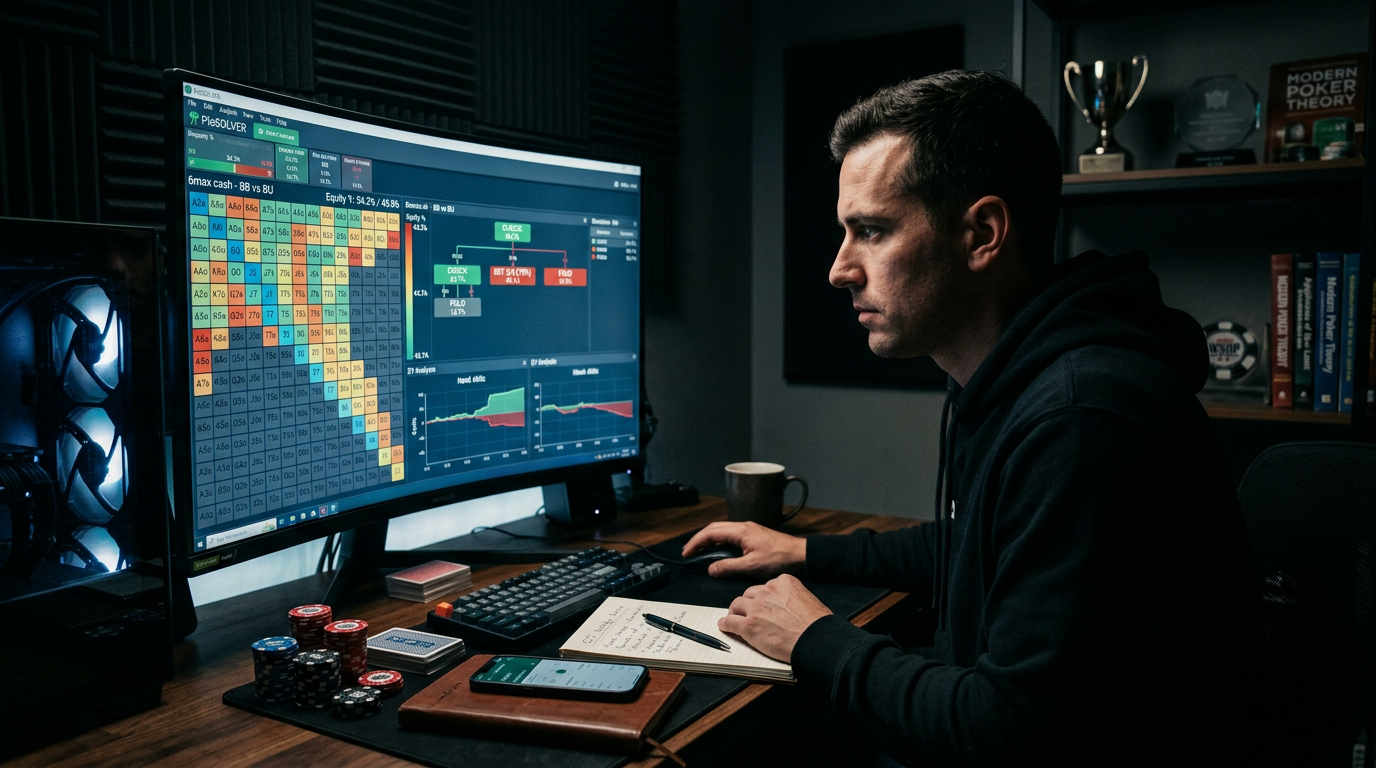
How to Study Poker With Solvers (Without Wasting Hours)
The first time I opened a solver, I stared at it for twenty minutes, generated a few random solutions, didn't understand what I was looking at, and closed it. I kept paying for the subscription for two more months without doing meaningful study because I didn't have a framework for how to use it.
That's the most common failure mode with solver study. Not that players can't understand the output — they can. It's that they open the tool without a process, get overwhelmed by frequencies and mixed strategies, and end up either not studying at all or generating solutions they can't connect back to their actual game.
This is the process I use now, after a few years of figuring out what actually works.
The Core Principle: Study Your Game, Not Abstract Poker
This sounds obvious but most players violate it. They open GTO Lab or Wizard, pick a random spot from a training video, solve it, and try to memorize the output. That's not useful study. The solver output for a spot you never play, at a stack depth you never encounter, with ranges that don't reflect your actual opponent pool — none of that translates.
Effective solver study starts from your own hand histories. Specifically, from spots that are coming up repeatedly in your sessions and where you feel uncertain or you're getting uncomfortable results.
Step 1: Find the Spots Worth Studying
Before opening a solver, spend time in your database. If you're using PokerTracker 4 or HM3, run positional reports filtered by street. Look for situations where:
- Your win rate in a specific spot is significantly worse than expected
- You're losing a disproportionate amount of chips in a specific position or action type
- You keep facing the same decision and don't have a clear answer
For me, this process surfaces two or three spots per month that warrant real solver study. Not twenty spots — two or three. Focused study on a few meaningful spots beats shallow coverage of everything.
Example of a real spot I identified this way: I was losing money specifically in BB vs BTN 3-bet pots on dry boards. My overall BB defense was fine; this specific configuration was bleeding. That's a concrete, addressable study target.
Step 2: Set Up the Solver Correctly
This is where most guides skip important details. The solver output is only accurate if the inputs reflect your actual game.
Stack depth. Set it to your actual effective stack in the hand, not a round number. If you're regularly playing 130bb deep in a specific configuration, solve at 130bb. The strategy at 100bb can differ meaningfully.
Ranges. Use ranges that reflect your actual game, not textbook GTO ranges. If you know BTN opens 35% in your pool instead of the GTO-correct 28%, that changes what BB's optimal defense looks like. GTO Lab lets you adjust preflop ranges before solving postflop — use this.
Bet sizes. Use the bet sizes that actually appear in your game. If nobody bets 75% pot in your pool and everyone bets 33% or pot, solve with those sizes. Generating solutions for bet sizes you never see or use produces useless output.
Rake. If you're using GTO Lab for preflop solves, enter your actual rake structure. Rake significantly affects borderline spots.
Step 3: Read the Output — Strategically
Here's the thing about solver output: you can't memorize frequencies. There are too many nodes, too many board textures, too many hand combinations. If your takeaway from a study session is "on Kh7s2d I should cbet 58.3% with this sizing," you've failed to learn anything durable.
What you're actually looking for:
Range advantages. Which player's range interacts better with this board? On Kh7s2d, the BTN's range has more strong kings and more air, while BB's range has more underpairs and medium-strength hands. Understanding that structural advantage explains why BTN is supposed to bet a certain frequency — not the number itself.
Polar vs condensed ranges. When should you use big sizing vs small sizing? Solvers use big bets when they want to separate strong hands from weak hands (polar range) and small bets when they want to bet their entire range profitably (condensed/merged range). Understanding this principle lets you extrapolate across board textures without memorizing each one.
Which hands are doing what and why. In any given node, sort hands by action. Look at which hands are always betting, always checking, and mixing. Ask yourself why — what properties do those hands have that make that action correct? Strong equity but needs protection? Blocking opponent's continuing range? Good as a bluff because it can improve?
Step 4: Build a Mental Model, Not a Lookup Table
The goal of studying a specific spot is to extract a general principle that applies beyond that exact spot.
After I worked through BB vs BTN 3-bet pot dynamics on dry boards, here's the principle I extracted: on boards where BTN has significant range advantage (lots of top pair+ hands that BB can't have as often), BB should check basically everything and BTN should bet a high frequency with appropriate sizing. When BTN checks back those boards, it's a range signal — BTN's range is capped. BB should play more aggressively on future streets when BTN checks back a board that favors them.
That principle applies across dozens of specific textures. Memorizing that on "Kh7s2d I should check-raise 22% of the time with this range of hands" applies to exactly one board.
Step 5: Take It to the Table (and Track It)
Study that doesn't change behavior is wasted. After each study session, write down one or two specific adjustments you're going to make in live play. Make them concrete enough that you'll recognize when the situation comes up.
"Play more aggressively in 3-bet pots on dry boards when BTN checks back the flop" is actionable. "Better range construction" is not.
Then track it. When those spots come up, note the result. After a few weeks, review whether your adjustments are moving in the right direction. This is where the database loop closes — study finds a leak, adjustments are made, database confirms improvement (or shows the adjustment needs refinement).
How to Structure a Study Session
I do roughly two study sessions per week, each 60-90 minutes. Here's what a session looks like:
15 minutes: Review hand database. Pull hands from recent sessions that fit the study topic. Export a few specific hands to review with the solver.
45-60 minutes: Solver work. Run the spot at the correct inputs. Examine the output strategically — range advantages, sizing logic, which hands are doing what. Test intuitive deviations and see what the solver thinks. Take notes on the principle being illustrated, not the specific frequencies.
10-15 minutes: Write the takeaway. One or two specific behavioral adjustments for live play. Add them to a running note I keep.
That's it. Two sessions per week, focused on spots from my own game, with deliberate output extraction. Over a year that's 100+ hours of quality study on exactly the spots that are costing me money.
Which Solver for Which Player?
This question comes up constantly.
GTO Lab ($49/month or $399/year) — My main tool. The preflop editor is excellent for building custom ranges before postflop analysis. Good for players who want to run custom spots rather than just browse pre-solved libraries. The 30% affiliate discount makes the annual plan genuinely good value.
GTO Wizard ($49-99/month) — Larger pre-solved library, slicker interface. Better if you mainly want to browse existing solutions for common spots rather than build custom solves. The Pro tier at $99/month adds custom solve functionality.
PokerSnowie ($29/month) — AI-based feedback in natural language. Good starting point for players who find raw solver output overwhelming. Not a replacement for GTO Lab or Wizard at serious study, but a more accessible entry point.
For most players at NL100-500 who want to study their own game seriously: GTO Lab annual. For players who mainly want to browse pre-solved content and are newer to solver study: GTO Wizard Essential. For very new solvers users: start with PokerSnowie for a month to build intuition, then graduate.
Things That Don't Work (That I've Tried)
Studying without a target spot. Opening the solver and just exploring random spots feels productive but isn't. You don't retain things you studied abstractly with no personal stake in the answer.
Memorizing frequencies. Impossible and pointless. Extract principles.
Studying for two hours straight. Diminishing returns set in fast. 60-90 minutes of focused study is more valuable than 3 hours of unfocused browsing.
Ignoring bet sizing inputs. Running solutions with default bet sizes produces output that doesn't match your actual game. Always set realistic bet sizes before solving.
Skipping the database review step. Jumping straight to the solver without first identifying which spots to study means you'll study irrelevant spots. Start from your data.
The Verdict on Solver Study
Done well, solver study is the highest-leverage activity available to a serious player. Done badly — random spots, wrong inputs, frequency memorization — it's an expensive way to feel like you're improving without actually doing it.
The process matters: identify spots from your own game, set up the solver correctly for your actual game conditions, read the output for principles not numbers, and track whether your adjustments improve your results.
Get GTO Lab or GTO Wizard. Build a database with PokerTracker 4. Study your game, not abstract poker. That combination, applied consistently over months, is how you actually get better.
A Detailed Look at How Solver Output Should Actually Be Read
I want to spend more time on this because it's where most players fail. The solver gives you a wall of numbers and colors. You can stare at it for an hour without learning anything if you don't have a framework for what to extract.
Here's the framework I use, in the order I apply it.
First pass: range advantage. Before looking at any specific hand, I look at the equity bar at the top of the screen. Solvers display each player's overall equity on the current node. On a board where one player has a clear equity advantage (say 60/40 or worse), the strategy will be heavily skewed — the favored player bets more and uses bigger sizings. On a roughly even equity board (52/48 or closer), the strategy is more nuanced and both players have meaningful action.
Just knowing "I have range advantage here" tells you most of what you need to know about high-level strategy without looking at specific hands.
Second pass: range composition. Next I look at the range itself, sorted by hand category. Most solver UIs let you see "what percentage of my range is two-pair-or-better, top pair, middle pair, draws, air." That distribution tells you how the strategy will play out. A range that's 30% strong made hands and 70% air is going to play very polarized — big bets that put pressure on opponent's middling hands. A range that's mostly medium-strength hands plays more passively.
Third pass: sizing logic. Now I look at the available bet sizings and which one the solver is choosing. Solvers usually have multiple sizing options (33%, 75%, pot, overbet) and they pick the one that maximizes EV given the range structure. The pattern: small sizings for condensed ranges that need to bet most hands profitably, large sizings for polarized ranges that want to separate value from bluffs.
Fourth pass: specific hands. Only now do I look at what individual hand types are doing. I sort the range by action — see all the "always bet" hands, the "always check" hands, and the mixed hands. Then I ask: what property unites the always-bet hands? What property unites the always-check hands? What's special about the mixed hands?
This four-pass workflow takes about 15 minutes per spot but it produces durable understanding. Compare that to the failure mode of "click around the solver looking at random nodes for an hour," which produces nothing.
Three Spots I've Studied This Year, and What I Learned
To make this concrete, here are three real spots I worked through in the past nine months and the principles I extracted from each.
Spot 1: SB Open vs BB 3-bet on Ace-High Boards
The setup: I open from the SB with my standard SB opening range, BB 3-bets, I call. Flop comes Ace-high. What's BB doing with their range?
What the solver showed: BB has a major range advantage on Ace-high boards because BB's 3-bet range has way more aces than my SB call range does (BB is 3-betting AA, AK, AQs, often AJs; my call range has very few aces because I 4-bet most of my AKs and AQs preflop). BB cbets a high frequency, often with a small sizing because they have so many strong hands they can bet most of their range profitably.
The principle I extracted: my SB-call-vs-3-bet range is structurally weak on ace-high flops because of how preflop construction works. Default to folding most of my range when BB cbets. Only continue with hands that have specific properties — pocket pairs that can call one street, suited connectors with backdoor potential, hands with an ace.
The application at the table: I had been calling too wide on Ace-high boards in this configuration, leaking maybe 1-2 BB/100 across this specific spot. After internalizing the principle, my fold rate increased and my winrate in 3-bet pots improved measurably.
Spot 2: BTN vs BB Single Raised Pot, Low Boards
The setup: I open from BTN, BB calls, flop comes 7h5h2c (or similar low coordinated board).
What the solver showed: this is the opposite of the previous spot. BB has a slight range advantage because their calling range includes more low pocket pairs and suited connectors that connect with this texture, while my BTN opening range is mostly high cards that miss. The solver checks back a high percentage of my range and bets only a polarized subset (sets, two pair, big draws, and some air with backdoor equity).
The principle I extracted: on low coordinated boards in BTN vs BB single raised pots, my default cbet should be small or skipped entirely. The texture is BB-favored. When I do bet, it should be polarized — strong hands and clear bluff candidates, not middling hands.
The application at the table: I was cbetting too high a frequency on these textures, autopilot from older training that emphasized cbet-or-die. Lowering my cbet frequency on these specific boards saved real money.
Spot 3: Turn Probe Bets after BTN Checks Back Flop
The setup: BTN opens, BB calls, flop comes (any texture), BTN checks back the flop, turn brings a card. Should I as BB bet the turn? With what hands? At what sizing?
What the solver showed: when BTN checks back the flop, their range is capped — they don't have the strongest hands (they would have bet) and they don't have pure air (they often bet some bluffs). Their range is medium-strength. My turn probe strategy on most turn cards involves a moderately high frequency with a smallish sizing, betting a wider range than people typically do.
The principle I extracted: a checked-back flop signals capped opponent. I should be aggressive on the turn, especially on cards that improve my range relative to theirs. Small sizings work because I want to bet wide and BTN's capped range can't comfortably raise.
The application at the table: I was checking too often after a checked-back flop, missing value and missing equity-denial opportunities. Increasing my probe frequency improved my BB winrate in single raised pots noticeably.
These three examples share a pattern. Each one identified a structural feature (range advantage, capped range, polarized vs condensed) and translated it into a behavioral change. None of them required memorizing specific frequencies. All of them came from working through the spot in the four-pass framework above.
Solver Setup: The Details That Actually Matter
I mentioned setup briefly above but it deserves more depth because incorrect setup is the silent failure mode that ruins solver study.
Preflop ranges. Most solvers ship with default preflop ranges that assume both players are playing GTO. If your opponent pool isn't playing GTO (which is true at every stake below NL1k), the default ranges produce strategies that don't reflect your reality. Adjust:
- BTN opens: default ~28% in 6-max GTO. Most pools open closer to 40-45% at low stakes. Use a wider range.
- BB defends: default ~62% vs 2.5x. Most pools defend closer to 50% at low stakes (folding too much). Use a tighter BB range when solving.
- 3-bets: default ~12% from BB vs CO. Most pools 3-bet much less (6-8%) at low stakes. Use a tighter, more value-heavy range.
These adjustments make the solver output match your actual game. The strategy against a pool that defends BB at 50% is different from the strategy against a GTO BB at 62% — your bluffing frequencies should be lower, your value sizings can be larger, your river overbets more profitable.
Bet sizings. The default sizing tree in most solvers includes 33%, 75%, and pot. In real games, different pools have different sizing distributions. If your pool primarily uses 50% pot cbets and rarely uses overbets, solve with 50% pot as a primary option. Adding sizings the solver can choose but your opponents never use produces output that doesn't apply.
Rake. This one specifically affects preflop solves. Most low-stakes online cash has high effective rake. If you solve preflop with the default 5% capped rake structure, you'll get tighter recommended ranges than if you solve with no rake. Use the actual rake structure of your pool.
Stack depth. Solve at the depth you actually play. Auto top-up cash games are usually exactly 100bb effective. Sit-down games or games without auto top-up can be all over the place. If you regularly play 130bb+ deep, your solves should reflect that.
The setup time investment is 10-15 minutes for a properly configured solve. Doing this once per study topic and reusing the configuration is a small price for output that actually matches your game.
What to Do With Mixed Strategies in Real Play
Solver output frequently includes mixed strategies — say a hand should bet 60% of the time and check 40%. New solver users get hung up on this because they can't physically randomize at the table.
The honest answer: at low stakes, just take the more frequent action and don't worry about it. The exploitability of "always bet" instead of "60% bet" is small at stake levels where opponents aren't tracking your ranges precisely. The cost of getting confused trying to mix is larger than the cost of slight imbalance.
At mid stakes (NL200+), mixing matters more because thinking opponents will eventually adjust to imbalanced ranges. There are several approaches:
Time-based mixing: take a different action depending on whether the seconds digit on your clock is even or odd. Crude but works.
Hand-based mixing: split mixed-action hands by suit or by specific card properties. For example, on a mixed-action hand class like A5s, take the value action with one suit (hearts) and the bluff action with another (clubs). Pre-decide your assignments.
Frequency approximation: just track approximately how often you're taking each action over time. If you're supposed to bet 60% of the time and you've been betting 80% recently, lean toward checking the next few times the spot comes up.
None of these are perfect. The solver assumes randomization that humans can't achieve. The goal isn't perfect mixing — it's not being so predictably one-direction that opponents can exploit you. Even rough approximation accomplishes that.
Building a Personal Study Library
After two or three years of serious solver study, you'll have worked through hundreds of spots. The learning compounds only if you can find your past work when a related spot comes up.
I keep a study notes file organized by spot type:
- BB defense ranges by opening position
- 3-bet pots by board texture category
- Single raised pots by position and board texture
- Multiway pot dynamics
- Specific spots I've identified as recurring leaks
For each spot, I record:
- The setup (who's involved, stack depth, preflop action)
- The range advantage and why
- The optimal sizing and why
- The specific hand classes that take each action
- The principle I extracted
- The behavioral change I'm making at the table
The notes are mostly text with occasional screenshots from the solver. The total file is now around 40 pages and I reference it during weekly study to refresh principles I've forgotten or to extend related spots.
This library is more valuable than any single solver session. The compounding insight from years of structured study notes is what separates players who improve consistently from players who study a lot but plateau.
When Solvers Will Mislead You
Solver output is technically correct given the inputs but the inputs are always assumptions. Several scenarios where the solver's "right answer" is wrong for your game:
Multiway pots. Solvers handle heads-up pots well but multiway dynamics are computationally harder and most solvers approximate. The optimal strategy in a 3-way or 4-way pot can differ meaningfully from what a heads-up solver suggests by extrapolation. For multiway spots, lean on equity calculators (which handle multi-way correctly) and use solver output cautiously.
Pools that play very differently from GTO. Against a very loose passive pool that calls everything and never bluffs, the solver's GTO mixed strategies are not the EV-maximizing answer. Pure exploitation is. Use solvers to understand the GTO baseline, then deviate aggressively against pool tendencies.
Live games with heavy reads. Live poker provides physical and behavioral information that no solver can incorporate. A solver might say to fold a hand at equilibrium; an obvious tell from villain might make calling +EV. Use solvers as a starting framework, not as gospel.
Spots not in your pool. If you study a spot that doesn't actually come up in your games (specific stack depths, specific bet sizing trees), the time was wasted regardless of how correctly you analyzed it. Always start from spots that recur in your sessions.
The solver is a tool for understanding theory. Your job is to apply that understanding intelligently to a game that's never quite the equilibrium scenario the solver assumes.
Picking Solver Sessions: A Practical Schedule
For players serious about improvement but with limited study time, here's the schedule that's worked for me:
Weekly (60-90 minutes per session, 2 sessions):
- One session focused on a recurring spot from the past week's hands
- One session on a specific concept (sizing theory, range construction, blocker effects)
Monthly (one extended session, 3-4 hours):
- Build a custom solve for a new spot type I haven't studied
- Review past month's notes and consolidate principles
- Identify next month's study targets based on database review
Quarterly (one full day, 6-8 hours):
- Comprehensive database review across positions, pot types, and board textures
- Build study targets for the next quarter
- Update preflop ranges based on any pool changes I've noticed
- Refresh memorized chart spots that have decayed
This schedule is sustainable for someone playing 15-20 hours a week. If you're playing less, scale down proportionally. If you're playing more, scale up but be careful about diminishing returns — past a certain point more solver work doesn't translate to more winrate.
The key is consistency over intensity. Two hours per week, every week, for a year is 100+ hours of focused study. That's enough to substantially improve your game. Eight hours a week for two months and then quitting because you burn out is roughly nothing.
What Beginners Get Wrong About Solver Study
A few patterns I see consistently from players new to solver study.
They start with too-advanced spots. A player just learning solvers tries to study river overbet bluff frequencies in 4-bet pots on paired boards. They have no framework for understanding the output and they get nothing from the session. Start with simpler spots — preflop ranges, basic cbet decisions, BB defense fundamentals — and build up.
They confuse "solver said do X" with "do X always." GTO is a baseline. The solver's recommendation is correct against a GTO opponent. Against your actual opponents, exploitative deviations are usually more profitable. Treat solver output as the starting point, not the answer.
They expect immediate ROI. Solver study is a long-term investment. The principle you internalize this month might not show up clearly in your winrate for three months. The compounding effect of better range construction, better sizing, better bluff frequency only becomes visible in the data over enough sample. Trust the process.
They study for too long per session. Diminishing returns set in fast. After 90 minutes of focused solver work your retention drops sharply. Two 90-minute sessions are worth more than one 3-hour session. Spread the study out.
They don't take notes. Working through a spot in real time and not recording the insights means you forget most of what you learned within a week. Always close a study session with a written takeaway.
The Bigger Picture
Solver study is one component of becoming a winning player. It's not the only one. Database review identifies leaks. Solver work explains them and produces solutions. Application at the table converts knowledge to winrate. Without all three, the whole system breaks down.
The players I know who have improved the most over the past five years all have similar patterns: they study consistently in moderate-sized sessions, they extract principles rather than memorizing frequencies, they apply specific changes at the table and track results, and they revisit material periodically to refresh decayed knowledge.
The players who haven't improved (despite spending money on tools) all share a pattern too: they study sporadically, they study random spots without connection to their own game, they expect insights to translate to winrate immediately, and they jump between tools and approaches without sticking to anything long enough to see compounding benefits.
Pick a tool. Build a process. Study consistently. Track outcomes. That's the whole formula and there's no shortcut. The good news is that doing this for two years will make you better than most players at your stake, simply because most players don't do it. The bar for actually using these tools well is low, and the reward for clearing it is real.