Poker Academy Review 2026: Worth It Next To GTO Lab?
I've used Poker Academy alongside GTO Lab for 13 months. Here's what the video library actually teaches you, who the coaches are, and whether the price holds up.
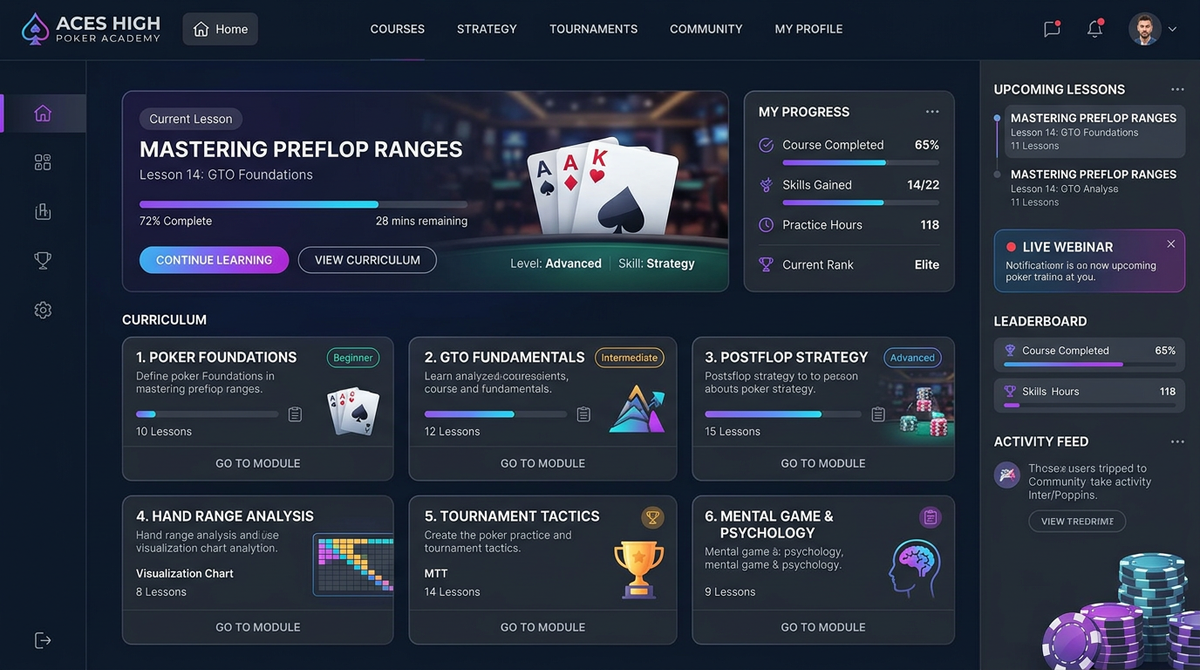
Poker Academy Review 2026: Worth It Next To GTO Lab?
There's a particular kind of poker player I run into all the time — usually somewhere between NL50 and NL200, plateaued for a year or more, who's tried two solvers and a handful of YouTube channels and still feels stuck. They ask me what to do next. My honest answer used to be "watch better content." But "better" is a vague word, and after a while I got tired of being vague, so I started actually paying attention to which video products were worth the money.
Which is how I ended up with a Poker Academy subscription in April 2025 that I've kept renewing for thirteen months. I didn't expect to like it. I'd assumed it would be another rotating cast of mid-stakes pros reading from PIO outputs, which is the genre we've all seen too much of. It turned out to be something genuinely different, though not without flaws. This review is me being specific about what those differences are.
I should mention up front that I write these reviews from a particular perspective. I'm Alex, a 6-max NL cash reg, nine years online, currently grinding NL200-500. I started reviewing poker software in 2022 mostly to organize my own thinking. I have no contractual relationship with Poker Academy. The links in this article are affiliate links — if you sign up through one, I get a cut, and the price you pay stays the same. The opinions are mine and I will absolutely say negative things about products I'm getting paid to refer because that's the only way the recommendations are worth anything.
Let me set up what we're actually evaluating. Poker Academy is a video-led poker training site with a library of structured courses, a coach-led drill mode, a discord community, and a basic study tracker. It is not a solver. It is not a HUD. It overlaps in some places with PokerSnowie on the conceptual training side, and it overlaps with PokerCoaching.com and Run It Once on the video library side. Where it fits in your stack depends on what's missing from your current study routine.
The Library: What's Actually In There
Poker Academy's library is organized into "tracks" and "labs." Tracks are sequential courses that build a skill over 8-30 hours of video; labs are one-off deep dives on a specific spot or concept. The track structure is the part I like most about the product.
I went through three tracks before I started writing this. The first was "Cash Game Fundamentals," which I treated as a refresher and which honestly bored me — it's aimed at players moving up from low stakes and most of it I already knew. The second was "Postflop Decision Trees," which is the one I'd recommend to anyone playing NL100 and above. The third was "Population Exploits in Modern Pools," which is the most current track in the catalog and the one I learned the most from.
That third track is worth describing in detail because it's not the kind of content you find in a free YouTube video. The instructor — a German pro who used to play higher than I currently do — goes through real hand histories from his own database, frame by frame, explaining where his line deviated from GTO and why. He's not reading from a script. The videos are long, sometimes 90 minutes, and they don't try to be entertaining. They're the closest thing to a one-on-one coaching session I've experienced in a video format.
The Track Structure Specifically
Each track has the same scaffolding: an introduction video, a sequence of 4-12 lessons, an in-track quiz after every 2-3 lessons, and a capstone session that ties everything together. The quizzes are not the kind of quiz I expected. They're hand history scenarios with explanations, not multiple-choice trivia. The capstone session involves an interactive set of spots where you make decisions and the platform shows you the consensus answer from the instructor's lab notes.
This structure is more thoughtful than most poker products. It's clear someone with actual instructional design experience laid it out. That's not a given in the poker training space, which is mostly produced by ex-pros with passion but no curriculum chops.
The Lab Format
Labs are shorter and more spot-specific. A typical lab is 25-45 minutes on a single concept — "Defending the BB against minraises on dynamic boards" or "When to triple-barrel polarized vs merged." There are hundreds of these in the library and they're refreshed monthly. The quality is uneven. Some labs are exceptional. Others feel like the instructor was trying to hit a content quota.
I keep a running list of which labs are actually good. The labs by Mike Brady and the labs by Linus Loeliger (yes, the high-stakes regular has done a small number of guest labs for them) are uniformly worth watching. The labs by some of the less famous coaches are hit or miss. There's no easy way to filter by quality, which is one of my bigger complaints — the library could use community ratings.
Pricing: What You Pay and What You Get
Poker Academy uses a tiered subscription model. They've been adjusting prices throughout 2025 and into 2026, and as of this writing the structure looks like this:
| Tier | Monthly | Annual | What's Included |
|---|---|---|---|
| Access | $29 | $299 | Full track library, lab library, community Discord |
| Plus | $59 | $599 | Everything + coach office hours, hand review submissions, exclusive labs |
| Pro | $129 | $1,299 | Everything + small group coaching, custom video reviews, 1-on-1 sessions |
The Access tier is the one most players should consider. $299/year works out to about $25/month, which is comparable to a single private coaching hour from a low-stakes coach but with vastly more content. I'm on the Access tier and I've never felt the need to upgrade.
Plus is for players who want feedback on their own hands. The coach office hours are roughly two hours a week, usually scheduled across different timezones, and you can submit hand histories ahead of time for review. If you don't already have a study group, this is a way to get external feedback on your own play. I'd guess about 20% of subscribers use this tier.
Pro is genuinely for serious players. $1,299/year is real money. You get personalized small-group sessions with a single coach over a 6-month or 12-month engagement. I haven't subscribed to this tier myself, but two regs in my study group did and both reported it was worth the price — though they also moved up two stakes during the year, so they could afford it.
Regional Pricing Notes
Like most poker subscription products, Poker Academy bills in USD. For grinders in Canada, Australia, New Zealand, the UK, or Ireland, here's what the Access tier roughly costs:
- ~$410 CAD / year
- ~$460 AUD / year
- ~$500 NZD / year
- ~£235 GBP / year
- ~€275 EUR / year
If you're in a country where poker income is taxed or where banking poker funds is awkward, factor that into your decision. $25/month in clean recurring USD billing is easier to manage than ~$60/month going through a payment processor that hates your bank.
What Poker Academy Does Better Than Its Competitors
This is the section that matters most. There are a lot of video products. Why this one?
1. The Instructional Design Is Real
This is the boring-sounding feature that actually makes the product work. Tracks have a defined arc. Lessons build on each other. Each lesson has a clear learning objective stated at the start. The quizzes test the right things. The capstone synthesizes.
In most competing products — and I've tried PokerCoaching, Run It Once, the older Tournament Poker Edge — the library is a pile of videos with metadata. You're left to figure out the curriculum yourself. Poker Academy gives you the curriculum. For a self-directed learner that might not matter, but most players, including me, study better with structure.
2. The Coaches Don't Read From Scripts
This sounds like a small thing but it changes the experience. A lot of poker video content involves a coach with a solver tab open reading the solution. Poker Academy's better instructors talk through their reasoning while showing you the solver output. The difference is that you're learning how to think, not what to think.
There's a specific lab I watched on river bluff-catching where the instructor spent eight minutes building intuition about blocker effects before he ever showed the solver output. By the time the solver came on screen I already knew what it would say. That's good teaching.
3. The Community Is Actually Active
The Discord that comes with any tier has about 4,000 members and the daily chat is real. Players post hands, get feedback, argue about specific spots. There are dedicated channels for cash, MTTs, microstakes, and high stakes. The mods are active and the conversation rarely devolves into the usual poker forum sniping.
I'd estimate that maybe 15% of the value I get from the subscription is the Discord. That's not a small percentage. A good poker community is hard to find.
What Poker Academy Does Worse
I'll be specific about the failures.
The Search and Filter Tools Are Bad
The library has hundreds of labs. The search bar is keyword-based and the filters cover only the broadest categories (cash vs MTT, stakes range, coach name). There's no way to filter by concept, by board texture, by position, by stack depth, or by quality rating. If you want to find "labs about polarized turn check-raises in single-raised pots," you're going to spend an hour scrolling.
I built my own spreadsheet to track which labs cover which concepts. That shouldn't be necessary in a paid product.
Mobile Video Playback Is Buggy
The mobile site supports video playback but the player is fragile. It loses position when you switch apps, the playback speed control disappears in landscape mode, and the captions don't always sync. I watch all my videos on desktop. The mobile experience is good enough for casual viewing but not for serious study.
Some Coaches Are Phoning It In
I won't name names because that's not how I want to do this. But there are at least three instructors in the library whose recent content is clearly produced fast and cheap. You'll watch a 30-minute lab and realize the coach hasn't really studied the spot — they're improvising on solver output. Poker Academy needs to either trim those coaches or hold them to a higher standard. Either is fine. The current middle ground is bad for the product's reputation.
No Solver Built In
You'd think a video-led platform that talks about solver output constantly would have an integrated solver. They don't. You're expected to bring your own — GTO Lab, GTO Wizard, InstaGTO, whatever. This isn't a fatal flaw but it does mean the subscription is additive: you're paying $25/month for Poker Academy plus another $25-50/month for a solver. Worth knowing.
How I Use Poker Academy in My Weekly Routine
Here's what an actual week looks like for me. Maybe it's useful as a template.
Monday — Track Lesson (60 minutes)
I'm working through one track at a time. Monday morning I sit down with coffee and watch one lesson from my current track. I take notes in the same Markdown file where I keep all my study notes. The lesson takes 30-50 minutes; the note-taking adds another 10-20.
Wednesday — Lab Deep Dive (45 minutes)
Mid-week I pick a single lab from a watchlist I maintain. The watchlist comes from things I noticed during my own play — if I felt unsure about a spot, I add a related lab to the queue. Wednesday is when I work through it.
Friday — Community Time (30-60 minutes)
Friday afternoon I spend in the Discord. I read the week's hand discussions, post any of my own hands that confused me, and answer questions from lower-stakes players. Teaching forces clarity. Some of my biggest breakthroughs in understanding came from explaining a concept to a NL10 grinder.
Saturday — Solver Crossover (90 minutes)
Saturday is solver day, and Poker Academy intersects with it. I'll take a concept from the week's track lesson and pull up the relevant solution in GTO Lab to verify and explore. The video gave me intuition; the solver gives me numbers. Both together is how the learning actually sticks.
Sunday — Review (30 minutes)
I end the week by re-reading my notes from Monday and Wednesday. Anything that doesn't make sense in retrospect goes on a follow-up list. The follow-ups become the next week's lab queue. It's a closed loop.
This routine consumes about 4-5 hours of study time a week, which is sustainable alongside playing. If you can't commit to 4 hours a week of study, Poker Academy is probably overkill — go cheaper with a single solver subscription.
Comparison to the Alternatives
| Product | Strength | Weakness | Annual Cost |
|---|---|---|---|
| Poker Academy | Structured curriculum, real teaching | No solver, bad search | $299-$1,299 |
| Run It Once | Deep library, elite coaches | Very expensive, dated UI | $999+ |
| PokerCoaching.com | Quizzes and drills | Lighter on real teaching depth | $599 |
| PokerSnowie | Conceptual training | Not a video product | $348 |
| Solo solver work | Cheapest path | No curriculum | $400-$1,200 |
Run It Once is the obvious comparison. RIO has a deeper library and arguably better elite coaches, but the cost is high and the curriculum is less organized. If you can pick up a curriculum from a pile of videos on your own, RIO is fine. If you can't, Poker Academy wins.
PokerCoaching.com is the more mass-market alternative. Their quizzes are good and their content is fine, but the depth is less. They aim slightly lower stakes than Poker Academy does. If you're at NL10-NL50, PokerCoaching might be the better fit. Above NL100, Poker Academy is more useful.
Questions People Ask
Will Poker Academy make you a winning player on its own? Probably not. You also need to be playing volume, reviewing your own hands, and using a solver to verify concepts. Poker Academy is one leg of a three-legged stool. If you treat it as the whole stool, you'll be disappointed.
Is it better for cash or MTTs? The cash library is deeper. There's MTT content but it's a smaller portion of the catalog. If you're a tournament specialist, I'd look at the dedicated MTT products (PokerCoaching, RIO MTT) first.
How current is the content? Track content gets refreshed every 12-18 months. Lab content is refreshed monthly. The most recent labs reference 2025-2026 player pool data, which is appropriately current. There are also older labs from 2022-2023 still in the library — they're labeled as such and the principles still apply, but specific exploit recommendations may have shifted.
Can you cancel anytime? Yes. The monthly plan is month-to-month and cancellation is one-click. The annual plan refunds prorated within 30 days. They're not playing games with retention.
Is there a free trial? Currently a 7-day trial exists on the Access tier. They've expanded and contracted this over the past year. Check the site at the time you're considering subscribing.
Does it work on Mac? Yes. The web app works on any modern browser. I'm on macOS Sonoma without issues.
How much time do you need to commit for it to be worth it? My rough threshold is 4 hours/week. If you can't put in that much, you're not extracting most of the value. At 8-10 hours/week you're getting most of what the product can give you. Beyond 15 hours/week the marginal value drops because you're outpacing the publishing schedule.
What about Poker Academy versus just buying solver time? It's a different category. Solver time gives you precision; Poker Academy gives you intuition. The right answer is both, but if you can only afford one and you're already analytical, buy the solver. If you can only afford one and you're more of an instinctive player who needs concepts spelled out, buy Poker Academy.
The Tracks I'd Actually Recommend In Order
Since I get asked this constantly, let me name names. These are the tracks that earned their hours from me, ranked by what I'd suggest a NL100-NL500 reg work through first.
1. Postflop Decision Trees. This is the foundation track. It walks you through how to think about flop-turn-river decisions as a connected sequence rather than three isolated bets. If you've never read PIO output before, this track will make all the other tracks comprehensible. 14 hours, dense.
2. Population Exploits in Modern Pools. The most valuable track in the catalog, and the one that justifies a year's subscription on its own if you actually apply it. The German pro who teaches it walks through real spots from his own database with explicit numerical deviations from GTO. About 18 hours, with 4-5 hours of dedicated lab work that goes with it.
3. River Decision Making. Highest leverage of any single area in modern cash. The track focuses on bluff-catching with marginal pairs, value betting with thin holdings, and the overbet/block-bet decision tree. I rewatch sections of this every few months.
4. 3-Bet Pots Out Of Position. Specifically the SB-vs-BTN and BB-vs-CO/BTN dynamic. This is where most NL200+ regs leak the most money and where the pace of population improvement has been slowest. Worth the 11 hours.
5. Cash Game Fundamentals. The one I called boring earlier. I still think it's boring for an experienced player, but I'd recommend it to anyone moving up from NL10-50 to NL100. The core concepts are right; the depth just isn't where you need it if you're already a winning reg.
The tracks I'd skip unless you're a tournament player are the MTT Foundations and Final Table Dynamics tracks. They're competently done but they're not the company's strength.
A Concrete Example Of Track Application
Let me walk through how a single concept from the Population Exploits track changed an actual line in my game.
The concept was "BB defense vs SB minraise opens at 100bb." The instructor's claim was that population in standard pools defends too narrow against SB minraises specifically — they default to BB-vs-BTN ranges and don't widen properly when the open comes from SB. The exploit is to attack the SB's open with a wider 3-bet range than GTO suggests, especially with hands that block SB's value continuance combos.
I'd been playing this spot too tight. After watching the lab and verifying the numbers in GTO Lab, I added about 1.5% of combos to my BB 3-bet range vs SB minraise — mostly suited connectors and offsuit broadways with a blocker. Across the next 30,000 hands of cash play, my SB-vs-BB single-raised pot WTSD% dropped from 36% to 31% as villains adjusted, but my pure 3-bet pot win rate from BB vs SB went up by about 4bb/100.
That's the kind of measurable change you can extract from a track if you actually do the work. Watching the video alone wouldn't have changed anything. The 90 minutes I spent verifying the spots in a solver and the 30 hours of focused play with the new range is what made the difference.
A Realistic Critique Of The Coach Roster
I've been polite earlier in this review about the inconsistency in coach quality. Let me be more specific without naming names, because the pattern matters.
There are roughly 18 active coaches in the roster as of May 2026. By my rough categorization:
- 6 of them produce consistently excellent content. These are the ones whose labs I'll watch sight-unseen.
- 7 of them produce variable content. Their best labs are great; their weaker labs feel rushed.
- 5 of them produce content I actively avoid. Either they're improvising on solver output, recycling concepts from older labs, or genuinely don't seem to study the spots they're teaching.
The product would be substantially better if the bottom 5 were either trimmed or held to a stricter quality bar. I've raised this in the user feedback channel on Discord more than once. The response has been polite acknowledgement and no visible action. That's a signal about how the company prioritizes quality vs catalog size.
If you subscribe, my practical advice is to identify the 6-8 coaches whose work you trust within your first month and treat their content as your primary signal. Anything from the rest is bonus material to evaluate case by case.
How Poker Academy Sits Next To Other Subscriptions
Most serious players end up paying for at least three things: a tracker, a solver, and some form of structured content. Here's how Poker Academy fits with each layer.
Next to a tracker. Poker Academy and your tracker barely interact. You'll occasionally watch a lab that mentions a stat you should track, but otherwise these are independent purchases. Whether you're on PT4, HM3, or DriveHUD 2 doesn't change the value you get from Poker Academy.
Next to a solver. This is where the real complementarity lives. The track content gives you concepts; the solver gives you precision. The right workflow is to watch a lab, identify the spots it discusses, then verify the numbers in the solver. That double-pass is what makes the concepts stick. If you only have one or the other, you're getting maybe 50% of the value of having both.
Next to coaching. Poker Academy's Plus tier office hours are a partial substitute for individual coaching, but only a partial one. If you can afford a private coach who specializes in your specific game and stake, that's still higher-value per dollar than Plus tier hours. If you can't, Plus is a reasonable compromise. Pro tier with a long-term coach engagement is closer to true private coaching.
Next to a study group. A small private study group of 3-5 regs at similar stakes is worth more than any video subscription, in my opinion. Poker Academy's Discord is decent but it's still a public forum; a private group of people who know your game is irreplaceable. If you have a study group, Poker Academy is an additive resource. If you don't, build one before you pay for video content.
What I'd Tell Someone Buying This For The First Time
A few practical notes.
The annual plan refunds prorated within 30 days. If you sign up and within a month decide it's not for you, you can get most of your money back. That's a fair policy and worth knowing because it removes the "trapped for a year" anxiety.
The track content is best consumed at 1.0x speed for the first watch and 1.5x for re-watches. The instructors aren't padding; they're explaining at a pace that matches the complexity. Speeding up the first watch will cause you to miss subtleties that the lab quizzes will then catch.
Take written notes during track sessions. The platform has no built-in note system per video. Use whatever you use for other notes. The act of writing the concept in your own words is what cements it.
Don't binge. The catalog is large enough that you'll be tempted to watch four labs back-to-back on a Saturday. Don't. Two videos a week with proper note-taking and follow-up solver verification beats eight videos a week with no follow-through. I've watched this fail in study group friends.
A Realistic Six-Month Outlook
If you sign up today and use the platform consistently for six months, what should you expect?
Realistic expectations: 2-3 tracks completed, 30-50 labs watched, around 80-150 hours of total study time, a noticeably more structured way of thinking about postflop decisions, and probably a 1-2bb/100 winrate improvement at NL100 and above if you're putting in commensurate play volume.
Unrealistic expectations: Doubling your winrate, beating two stakes higher than you currently play, or "solving" any specific spot completely. None of those happen in six months from any subscription. If a product promises that, the product is lying.
I've been on the platform for 13 months and the cumulative effect has been substantial. But each individual month feels small. The compound interest of structured study is real and it's why I keep renewing, but if you sign up expecting a transformation in week three you'll be disappointed and you'll cancel before the actual gains arrive.
Verdict: A Real Course Library, With Caveats
I've stayed subscribed to Poker Academy for thirteen months because the track structure has materially changed how I study. I've worked through three tracks and started a fourth, and each has produced specific changes in how I play certain spots. The "Population Exploits" track alone is worth the year's subscription for any reg who plays in standard online pools.
That said, the product has real weaknesses I want you to factor into your decision. The search is bad, the mobile experience is mediocre, and a noticeable minority of coaches are producing low-effort content. The site needs a quality bar that's enforced from the top, not from individual discretion.
For an experienced player who already has a solver and wants structured concept training to complement it, Poker Academy's Access tier at $299/year is one of the better video-led products I've used. The instructional design is real, the better coaches are genuinely teaching rather than just showing solver outputs, and the community is one of the more functional poker Discords I've encountered.
For a player who's looking for their first piece of paid software, I'd point them at a solver subscription instead — GTO Lab or PokerSnowie depending on level. Concepts without practice don't stick, and the solver gives you the practice. Once that's in place, Poker Academy becomes a high-value addition.
I'll renew in April 2026. Whether you should subscribe depends on whether you already have the foundation that lets Poker Academy build on top of it. If you do, this is good content. If you don't, fix the foundation first and come back.