Poker Solver vs Poker Trainer: The Real Difference (2026)
What's actually different between a GTO solver and a poker trainer? When do you need each? An honest breakdown for players choosing their first study tool.
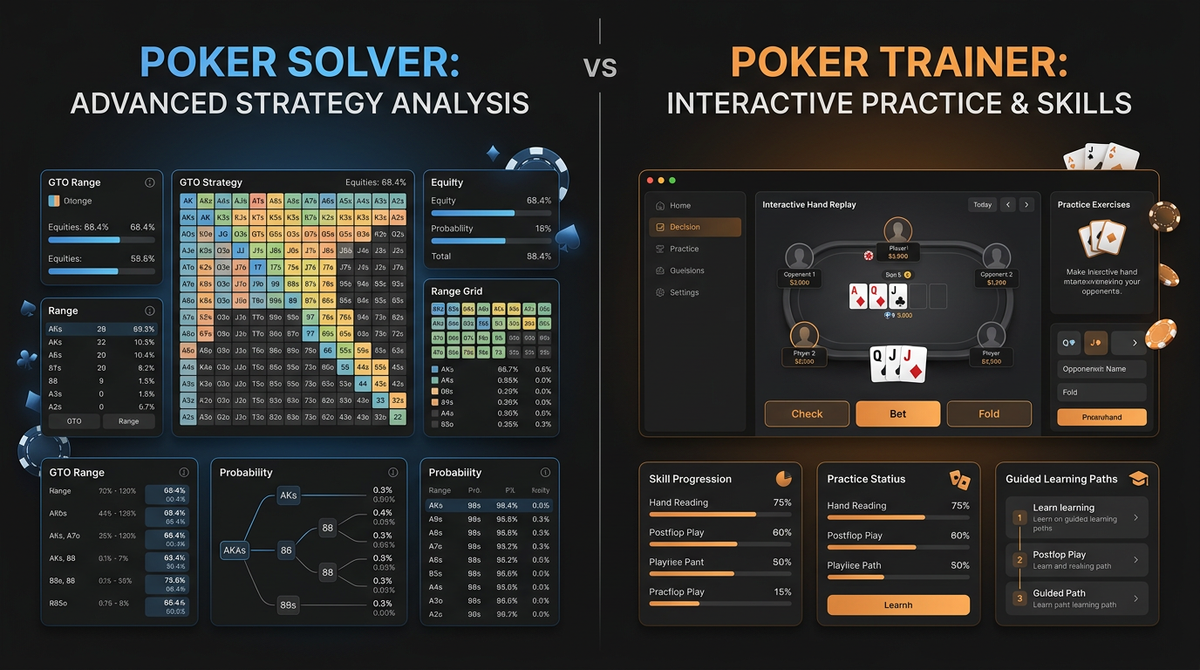
Poker Solver vs Poker Trainer: The Real Difference (2026)
A guy in my Discord asked me last week, "Should I get GTO Wizard or PokerSnowie? They both teach you GTO right?" I had to take a breath before responding because it's the kind of question that reveals a deeper confusion. They both involve GTO, sure. But they're solving different problems and they belong to different categories of software. Treating them as interchangeable is like asking whether you should buy a microscope or a textbook to learn biology — they both relate to biology, they both have value, and they do completely different things.
This article exists because the poker software market has gotten genuinely confusing in 2026. The line between "solver" and "trainer" has blurred. Many products do both. Marketing copy uses the terms loosely. Beginners end up buying the wrong tool for their actual problem and wasting both money and study time.
I'm going to give you the clearest possible breakdown of what a solver actually is, what a trainer actually is, where they overlap, and how to choose between them based on your specific situation. I'll name names and recommend specific products. By the end you'll know whether you need GTO Lab or PokerSnowie, GTO Wizard or Poker Academy, or some combination — and you'll know why.
I've been studying poker with both categories of tool since 2018. I currently use a solver as my primary daily study and a trainer mode (which is a different thing, embedded inside the solver) for warm-up reps. I've made the mistake of confusing them. I've watched students do the same. This is the explainer I wish someone had given me.
The Definitional Difference
Let me be precise about terms because the precision matters.
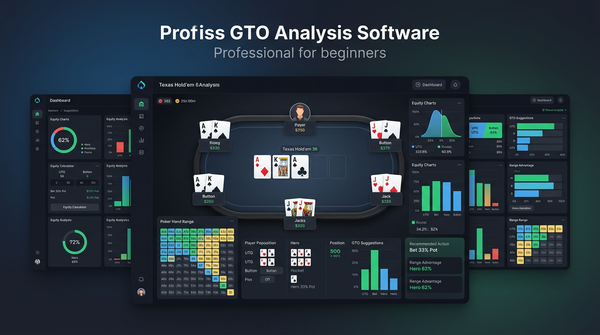
A solver is software that computes the unexploitable strategy for a specific poker situation. You give it inputs (positions, ranges, stack depth, bet sizes allowed), and it outputs the game-theory-optimal play for both players. The output is typically presented as a range matrix — a 13×13 grid showing what the optimal player does with each starting hand at the current decision point. Solvers exist to help you study why specific spots play specific ways. They reward you for spending time analyzing outputs.
Examples of pure solvers: PioSolver, Simple Postflop, TexasSolver. Browser-based modern solvers: GTO Lab, GTO Wizard, InstaGTO.
A trainer is software that drills you on poker decisions and gives you immediate feedback. You're shown a situation (often a hand to play), you choose an action, and the trainer tells you whether that action was correct or how it deviated from the correct play. Trainers exist to build your in-game decision-making muscle through repetition. They reward you for showing up consistently and getting reps in.
Examples of pure trainers: PokerSnowie, preflop range trainer apps, the trainer modes that come bundled with most modern solvers.
The key distinction: solvers produce outputs you analyze. Trainers produce feedback on your actions. Both are valuable. They're not the same thing.
A useful analogy: a solver is like a coach showing you film of professional game footage and explaining the strategic structure. A trainer is like a coach making you do drills until your muscle memory is ingrained. You need both forms of learning. Watching film alone won't make you faster; doing drills alone won't teach you strategic concepts.
Where the Categories Overlap
In 2026, most modern solvers include a trainer mode. GTO Wizard's trainer is widely considered the best trainer in the industry. GTO Lab has a comparable trainer integrated. InstaGTO has a more basic one. So when you buy a "solver," you're often getting a trainer bundled in.
This is good for users — you get both tools in one subscription. It's also confusing because it blurs the categorical distinction. The product is a solver that includes trainer features. The trainer features are subordinate to the solver's main job (producing outputs you analyze).
Conversely, some pure trainers (like PokerSnowie) include some solver-like outputs. PokerSnowie will show you the action you should have taken and the EV of various options. So it has solver-adjacent functionality, but it's not really a solver — you can't input custom situations or analyze ranges in depth. It's a trainer that shows some solver-style data.
Net result for buyers: don't think "solver vs trainer" as an either-or choice. Think about your dominant need (analysis vs reps) and let that drive which product category you buy. The bundled features will usually cover the secondary need.
What a Solver Actually Does for You
Let me make solvers concrete with a specific use case.
Scenario: I played a hand last night where I 3-bet AKo from the BB vs a CO open. Opponent called. Flop came J94 two-tone. I cbet small. Opponent called. Turn was a 7 of the flush suit completing the flush. I bet big and got check-raised all in. I called and lost to a flush.
After the session, I open GTO Lab. I navigate to BB vs CO 3-bet pots, J94 flop, configure the turn as a flush-completing card. I look at how the solver plays AKo on this turn.
The solver tells me:
- AKo bets turn at 35% frequency, mostly small
- AKo big bets turn at only 8% frequency
- The solver check-folds AKo or check-calls a moderate bet at 57%
I learn that my big turn bet was probably a mistake — AKo on a flush-completing card prefers to slow down. The solver also shows me what hands do want to bet big (sets, two pair, top pair top kicker that aren't blocking villain's flush range), which gives me intuition for the structural logic.
This is solver work. I came in with a specific question, I produced a specific answer, and I learned something I can apply to similar future situations.
What a solver does well:
- Answers specific "what should I do here" questions
- Shows you the structural logic of why ranges play certain ways
- Lets you compare similar situations to build pattern recognition
- Provides EV-precise assessments of decisions
- Handles non-standard scenarios (custom positions, stack depths, etc.)
What a solver doesn't do well:
- Build in-game decision speed (you're analyzing, not deciding)
- Teach you to handle pressure (no time constraint)
- Produce feedback on your actual decision-making patterns
- Replace the muscle memory of repeated reps
What a Trainer Actually Does for You
Now the same scenario but with trainer-style work.
Scenario: I'm using GTO Wizard's trainer mode for 15 minutes before a session. The trainer randomly shows me preflop decisions. UTG opens, I'm in the BB with 99. What do I do? I click "call." The trainer scores my decision: 85% accuracy on this spot. The correct GTO action is mostly call with some 3-bet at low frequency. I would have done that.
Next spot: BTN opens, I'm in SB with KQs. I click "3-bet large." Trainer scores me at 92%. Correct.
Next spot: CO opens, I'm in BTN with A4o. I click "fold." Trainer scores me at 67%. The solver actually 3-bet bluffs A4o at moderate frequency in this spot — I missed a bluff opportunity.
I do this for 15 minutes. At the end, the trainer shows me my session stats: 74% overall accuracy, weakest spot was 3-bet bluffing in late position vs CO opens.
This is trainer work. I didn't deeply analyze any spot. I drilled decisions, got feedback, and identified a pattern (I underbluff in late position).
What a trainer does well:
- Builds decision-making speed through repetition
- Provides immediate feedback on your actual choices
- Identifies recurring patterns in your play
- Pre-game warm-up to prime your decision-making
- Sustains daily study habit because sessions are short
What a trainer doesn't do well:
- Deep analysis of specific spots
- Teaching the underlying logic of why a play is correct
- Handling custom scenarios you specifically want to study
- Multi-street strategic reasoning
The Useful Mental Model
Here's how I think about it after years of using both.
Solver = analysis tool. You go in with a question, you come out with understanding.
Trainer = practice tool. You go in to do reps, you come out with sharper intuition.
A serious study routine uses both. The solver is for the targeted, deep work — usually 1–2 sessions per week of 60–90 minutes each. The trainer is for the daily sustaining work — 15–30 minutes most days.
A common failure mode: using only one. Players who use only solvers tend to know a lot of theory but make slow, second-guessing decisions at the table. Players who use only trainers tend to make fast decisions but can't explain why their strategy is what it is and struggle when situations don't match their drilled patterns.
Another common failure mode: confusing the two. Players who treat their solver like a trainer (rapidly clicking through spots without deep analysis) get neither benefit. Players who treat their trainer like a solver (trying to understand the deep logic of every drilled spot) lose the muscle-memory benefit.
Use them for what they're for.
When You Need a Solver Specifically
A solver becomes essential when:
- You have specific questions about your own play (hand history review)
- You want to understand the structural logic of why certain plays work
- You're trying to identify patterns across similar spot categories
- You're studying advanced concepts (node locking, exploitative deviations, pop-specific adjustments)
- You're at stakes where small EV differences add up to real money
A solver is overkill when:
- You can't yet recall preflop ranges from memory
- You don't have your own hand history to study
- You play sub-1,000 hands a month
- You're a complete beginner without a strategic framework
For someone in the "overkill" category, start with cheaper tools (a free HUD, free range charts, equity calculators) and grow into a solver subscription.
When You Need a Trainer Specifically
A trainer becomes essential when:
- Your in-game decisions feel slow or stressful
- You're rebuilding intuition after time away from poker
- You're learning a new format and want to drill its specific spots
- You play limited volume but want to maintain decision sharpness
- You need a low-friction way to sustain daily study
A trainer alone is insufficient when:
- You want to understand why a play is correct (trainer just tells you what)
- You want to study specific scenarios you've encountered
- You're at stakes where deep theoretical understanding matters
Most players who buy a "trainer" eventually want solver capabilities and either upgrade or buy both.
Specific Product Recommendations
Mapping the categories to actual 2026 products:
For solver-primary players:
- GTO Lab at ~$49/month — beginner-friendly, comprehensive cash library, includes trainer mode. My current pick for most cash regulars.
- GTO Wizard at $49–$99/month — more format coverage (cash + MTT + spin & gos), best-in-class trainer, more expensive. Right for multi-format players.
- PioSolver at $200+ once — advanced desktop solver for custom work, Windows only, steep learning curve. Add as a second tool after you've outgrown browser solvers.
For trainer-primary players:
- PokerSnowie at $29/month — pure trainer experience, neural network feedback (red/yellow/green), most beginner-friendly tool in the category. Outgrown after 3–6 months.
- Poker Academy — broad-spectrum training site combining videos and structured drills. Good for foundational learning.
For players wanting both bundled:
- GTO Lab and GTO Wizard both include trainer modes. The trainer features in modern solvers are mature enough that you don't need a separate trainer subscription.
Recommendation by player type:
- Pure beginner with no foundation: PokerSnowie for 2–3 months to build base intuition, then graduate to GTO Lab.
- Beginner with some foundation: skip the trainer-only step, start with GTO Lab and use its built-in trainer.
- Cash game regular: GTO Lab primary, use trainer mode 15 min daily.
- Multi-format player: GTO Wizard primary.
- Advanced player wanting custom work: GTO Lab or Wizard + PioSolver as secondary.
Comparison Tables
| Aspect | Solver | Trainer |
|---|---|---|
| Primary purpose | Produce outputs to analyze | Drill decisions for feedback |
| Session length | 30–90 min deep work | 5–30 min reps |
| Learning style | Active analysis | Active practice |
| Best for | Understanding why | Building speed/intuition |
| Cost in 2026 | $29–$99/month | $29/month standalone, often bundled |
| Examples | PioSolver, GTO Lab, GTO Wizard | PokerSnowie, app-based range trainers |
| Tool | Type | Price (2026) | Sweet spot |
|---|---|---|---|
| GTO Lab | Solver + integrated trainer | ~$49/mo | Cash regs, beginner-friendly |
| GTO Wizard | Solver + best trainer | $49–$99/mo | Multi-format, advanced |
| InstaGTO | Solver + basic trainer | ~$29/mo | Budget cash players |
| PokerSnowie | Trainer with solver-style data | $29/mo | Pure beginners |
| PioSolver | Pure desktop solver | $200+ once | Advanced custom work |
| Poker Academy | Hybrid training site | Varies | Foundational learning |
| Common confusion | Reality |
|---|---|
| "PokerSnowie and GTO Wizard are similar" | Different categories — Snowie is trainer, Wizard is solver |
| "I just need one tool" | Modern solvers bundle trainers; one purchase usually enough |
| "Solvers tell you the right play" | Solvers tell you the unexploitable play, which differs from "best vs your specific opponent" |
| "Trainers will fix my game" | Trainers build speed; solvers build understanding; both needed |
| "I should solve every spot I'm unsure about" | Better to solve a few spots deeply than many shallowly |
A Realistic Weekly Study Plan Using Both
Here's how I actually integrate both categories in a typical week.
Monday (45 min): Solver work. Pull a recent leaky spot from my database. Spend the session deep-diving on solver outputs. Goal: understand one specific structural pattern better than I did last week.
Tuesday (15 min): Trainer reps. Random spots in GTO Lab's trainer. Pre-session warm-up.
Wednesday (45 min): Solver work. Comparative study — pick a flop type and look at how the solver plays similar starting situations across 5–10 examples of that texture.
Thursday (15 min): Trainer reps. Focused on the spot category I worked on Monday — drill the patterns I studied.
Friday (60 min): Solver work. Hand history review. Pull 5 hands from the week. Run each through the solver. Document differences between what I did and what the solver does.
Saturday/Sunday (15 min trainer if motivated): Light maintenance only. Mostly play.
Total weekly study: ~3.5 hours, split roughly 75% solver work and 25% trainer work. The solver work produces understanding. The trainer work converts that understanding into faster in-game decisions.
You can adjust this ratio. A new player might want more trainer work and less solver work to build intuition before deepening analysis. An advanced player might want more solver work and less trainer work because their decision speed is already high.
Things People Get Wrong About This Choice
A few patterns I see consistently.
"I'll just use the trainer — it's cheaper." False economy. The trainer drills you on what the solver tells you. Without solver-level understanding, the trainer's feedback becomes opaque. "Why is bet 33% pot the right answer here?" The trainer won't explain; the solver will.
"I'll just use the solver — trainer is for beginners." Also wrong. Solver work without trainer reinforcement leaves you slow at the table. Even GTO Wizard's free tier trainer is worth daily use for any serious player.
"I should use a trainer until I'm ready for a solver." Possibly, but the bar is low. If you have preflop ranges memorized and basic equity intuition, you're ready for the solver. PokerSnowie can be a stepping stone but most players spend too long there.
"More tools = better." No. One solver + the integrated trainer is enough for nearly all players up through mid-stakes. Adding PokerSnowie when you have GTO Lab is duplicating capability you already have.
"Trainer accuracy is what matters." Misleading. Your trainer accuracy is a leading indicator of in-game performance, but the goal is real-money winrate. A player with 88% trainer accuracy who plays 5 hours a week will outperform a player with 95% trainer accuracy who plays 1 hour a week. Application beats theoretical accuracy.
Things I Wish I'd Understood Earlier
A few specific lessons.
The trainer is a complement, not a substitute. I tried to skip trainer work for years because I thought "I already know this stuff from solver study." Then I added 15 daily minutes of trainer work and watched my early-session decision speed improve. Reps build different muscle than analysis.
Solver depth matters more than breadth. I used to study many spots shallowly. Now I study fewer spots deeply. The pattern recognition I get from spending 30 minutes on one spot beats what I got from 30 minutes on five spots.
The trainer reveals leaks the solver doesn't. Solver work reveals theoretical leaks (e.g., my fold-to-3bet is too high). Trainer work reveals decision-pattern leaks (e.g., I freeze when faced with unusual sizings). Both leak categories are real and matter.
Bundle savings are real. Buying a separate solver and a separate trainer in 2026 is silly. Modern solvers include trainer modes that are good enough. Buy one subscription and use both features.
Time is the constraint, not money. A $49/month subscription is trivial relative to the value it produces if you use it. The constraint is whether you actually study consistently. Most players who quit a solver subscription do so because they didn't have the discipline to use it, not because the product was wrong.
The Verdict
Solver and trainer are different categories of poker software. A solver helps you understand poker better; a trainer helps you make poker decisions faster. You need both, and in 2026, you can get both in a single product (most modern solvers include trainer modes).
If you're choosing your first study tool: get GTO Lab at ~$49/month. It's a solver with a built-in trainer, beginner-friendly interface, and comprehensive cash game coverage. The trial will tell you in two weeks whether the product fits your study style.
If you specifically want the best trainer in the industry: GTO Wizard premium tier. More expensive but best-in-class trainer mode and the broadest format coverage. Right for serious multi-format players.
If you're a complete beginner who's never used either category: try PokerSnowie at $29/month for 2–3 months to build base intuition with the friendliest UI in the space, then graduate to GTO Lab once you can read solver outputs.
The bigger lesson is this: don't agonize over the solver vs trainer choice. Most modern products bundle both. Pick one good product, commit to using it consistently for a year, and resist the urge to add more tools until you've truly outgrown the one you have.
The tool isn't the bottleneck for most players. Discipline is. Pick a tool this weekend, set a 15-minute daily reminder, and show up. Six months from now, the choice you made between Snowie and GTO Lab will matter less than the consistency of your daily practice.
Whichever tool you choose — make it work. The category distinction matters less than the daily habit.
A Week Combining Solver and Trainer Work
To make the abstract solver-vs-trainer split concrete, here's exactly how I split a week between the two using GTO Lab as my primary tool. Last week as the example.
Monday morning, 50 minutes — solver-heavy. Pulled up Sunday's losing session in PokerTracker 4. Filtered for hands where I lost more than 1.5bb on the turn. Six hands. Four of them were turn check-raise spots where I bet, got check-raised, and had to make a tough decision. Opened GTO Lab. Spent the session deep-diving on turn check-raise defense as the IP single-raise pot aggressor. Built understanding of which hands fold vs which call. Pure analysis work — no time pressure, no scoring, just trying to understand why the solver does what it does.
Tuesday evening, 18 minutes — trainer-heavy. Pre-session warm-up. Random spots in GTO Lab's trainer mode. Scored 76% accuracy. Worst category was facing turn check-raises (the exact thing I'd just studied Monday). Reps reinforced the new understanding under simulated time pressure.
Wednesday morning, 40 minutes — solver-heavy. Comparative study. Picked turn check-raise spots and looked at how they vary across five different flop textures: paired (KK7), monotone (Jh7h2h), high static (A72r), middle dynamic (T98r), low coordinated (765r). Pattern recognition mode. The solver's defense changes meaningfully based on flop texture in ways I'd been ignoring. Documented.
Thursday evening, 12 minutes — trainer-heavy. Focused trainer session on turn check-raises specifically. Accuracy on this subset jumped from baseline 71% to 84% by session end. The solver work from Wednesday was being converted into faster decisions through trainer reps.
Friday morning, 65 minutes — mixed. Hand history review. Pulled five hands from the week, three of which were turn check-raise situations (the topic). Ran each through GTO Lab. EV gap across all five: about 4.8bb. The solver work + trainer reps had visibly tightened my play already, but there was still real EV being left on the table.
Saturday and Sunday — trainer only when motivated. Light maintenance trainer sessions of 8–10 minutes if I felt like it. Mostly just played.
Total weekly time: about 3 hours. Roughly 60% solver work (analysis-mode), 30% trainer work (rep-mode), 10% hand history review. The exact split varies week to week depending on what I'm focused on, but the pattern is consistent: solver builds the understanding, trainer converts it to in-game speed.
Both modes are necessary. Solver work alone leaves me slow at the table because I haven't drilled the patterns under pressure. Trainer work alone leaves me unable to explain why I do what I do, which means I freeze when situations don't match my drilled patterns. The two together produce both depth and speed.
The Spots Where Solver and Trainer Diverge Most
A more granular pass on which kinds of spots benefit most from each mode of study.
Solver-best spots:
- Multi-street decisions where understanding the full game tree matters (3-bet pots played to river)
- Unusual stack depths where my intuition is weakest (40bb, 200bb)
- Custom situations specific to a hand I played (recreate exact spot, see EV gap)
- Comparing similar textures to build pattern recognition (5+ ace-high flops side by side)
- Node-locking studies (what if villain over-folds turn?) — only solvers do this
- Population-specific deviations from the unexploitable baseline
Trainer-best spots:
- Preflop range drilling at common stack depths (the rep volume matters)
- Common postflop spots that come up every session (need decision-speed)
- Pre-session warm-up to prime decision-making for the night
- Post-time-away rebuilds (when intuition has gotten rusty)
- New format learning where you need to internalize a different range structure
Spots that need both:
- Most leak fixes. Identify the leak with database. Understand it with solver. Drill it with trainer.
- Anything that recurs frequently and matters EV-wise. Build the model with solver, internalize with trainer.
The mistake I see most often: trying to solver-study spots that need trainer reps (preflop ranges), or trying to trainer-drill spots that need solver analysis (multi-street planning). Mode-matching matters.
What I'd Tell Someone Choosing Their First Tool
If you've decided you want to invest in either a solver or a trainer and asked me which to start with, the answer depends on where you are.
If you don't have preflop ranges memorized: Start with a trainer. PokerSnowie or any free preflop trainer app. You need to drill preflop fundamentals before any postflop study makes sense. Two to three months of trainer work first, then add the solver.
If you have preflop ranges down but no postflop framework: Start with a solver that includes a trainer. GTO Lab at ~$49/month. The trial gives you both tools. You'll use the trainer for preflop maintenance and the solver for postflop understanding from day one.
If you already have a postflop framework but make slow decisions at the table: You need more trainer work, less solver work. The solver isn't your bottleneck anymore — execution speed is. Daily 20-minute trainer sessions for a month will move the needle more than another 5 hours of solver work.
If you make fast decisions but feel like you're missing strategic depth: You need more solver work, less trainer work. The trainer reps have built decision speed but the underlying model is shallow. Targeted solver deep-dives on your weakest spot categories will produce more growth than another month of trainer reps.
If you're not sure what you need: Start with GTO Lab. The bundled solver + trainer covers both bases. After a month you'll know whether your gap is more on the analysis side or the rep side, and you can shift your daily routine accordingly.
The point is to diagnose your bottleneck before you spend money. Most beginners assume they need more theory (solver) when they actually need more reps (trainer). Most intermediates assume they need more reps when they actually need more theory. Match the tool to the actual gap.
Six Months Later: Has My Solver-Trainer Split Changed?
I wrote a version of this article for a coaching client about six months ago. The frameworks haven't changed, but my personal split has.
More trainer reps, fewer solver hours. Six months ago I was at roughly 70% solver work and 30% trainer work weekly. Now it's 55/45 — meaningfully more trainer time. The shift came from realizing my decision speed at the table was a bigger bottleneck than my theoretical depth. The solver work I was doing was producing diminishing returns; the trainer work was producing measurable accuracy gains.
Trainer mode quality has improved. GTO Lab's trainer in particular has gotten meaningfully better in the last six months. The "weakness report" granularity now drills down to specific spot subcategories ("you're weak in 3-bet pots OOP on monotone flops vs CO opens") rather than broad ones. That granularity is the difference between knowing you have a leak and knowing exactly what to drill to fix it.
Less time agonizing over which tool to use. Six months ago I'd switch between solver tabs and trainer mode and feel productive. Now I'm more deliberate — solver sessions are clearly solver sessions (45+ minutes of focused analysis), trainer sessions are clearly trainer sessions (15-minute rep blocks). Mode-matching reduced wasted time.
Pre-session warm-up is now non-negotiable. A 10-minute trainer session before sitting down to play has measurably improved my early-session results. Six months ago I'd go 30 minutes into a session before making my first sharp decision. Now I'm sharp from hand one because I've already drilled fifteen random spots that morning.
Coaching has become more solver-focused. When I work with my coach now (quarterly, $200/session), the conversations are almost entirely about solver outputs and structural understanding. The trainer work I can do alone. The deep theory questions where I'm not sure I'm interpreting solver outputs correctly — that's where coaching adds the most value.
The summary at six months in: the solver-vs-trainer distinction still holds. They're still different modes of study, they still produce different kinds of improvement, and you still need both. What's changed is that I've gotten better at matching the mode to the actual problem, which is the meta-skill that takes years to develop. If you're starting today, the solver-trainer framework is the right mental model to internalize early. The exact split between them will shift as you progress, but the framework stays.