Poker Training Software Comparison 2026: What I Actually Use
Comparing GTO Lab, GTO Wizard, PokerSnowie, Poker Academy, and the rest in 2026 — from a NL200-500 grinder who's tested all of them in real study sessions.
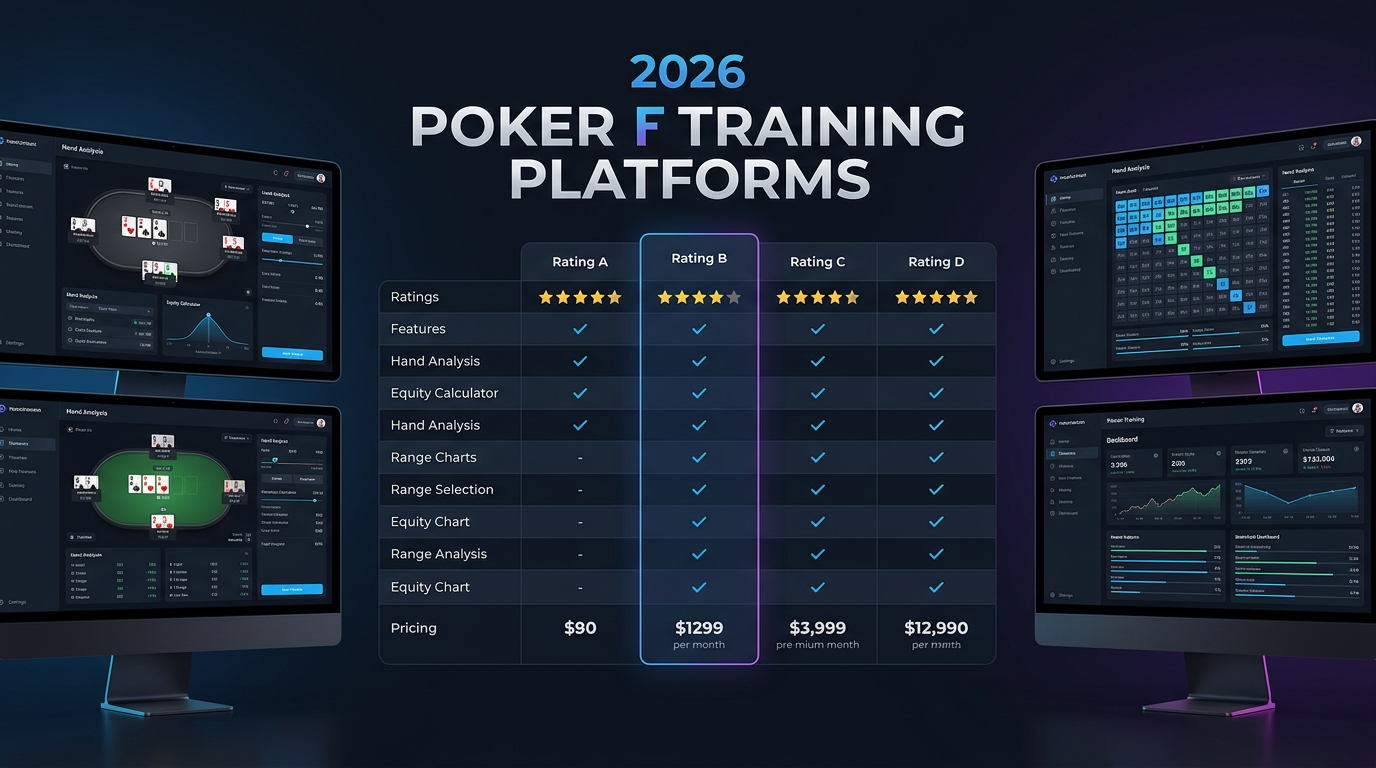
Poker Training Software Comparison 2026: What I Actually Use
In 2024 I spent $1,400 on poker training software in a single year. Subscriptions to two solvers, an annual training site, a HUD upgrade, a course bundle, and a study tracker. I figured if I just had access to enough quality material, I'd inevitably improve. By the end of the year my winrate hadn't moved and I was burned out from constantly switching tools.
That experience taught me something most "best poker software" articles don't tell you. The number of tools doesn't matter. The depth of use matters. A player who uses one solver for 200 hours a year will outperform a player who uses four for 50 hours each. Software is force-multiplier; without the discipline to actually study, it's just a more expensive way to feel like you're improving.
So this comparison isn't a feature checklist. I'm going to walk through every category of poker training software in 2026 — solvers, training sites, equity tools, range trainers, video courses, and database tools — and tell you what's worth your money based on where you actually are in your poker journey. I'll name names, give real prices, and tell you which ones I currently use vs which ones I tried and dropped.
I've been a NL200-500 cash 6-max regular for years. I've tested most of these in actual study, not just demo videos. I'll be opinionated. The categories below are roughly in order of importance for an improving player.
Category 1: GTO Solvers (The Centerpiece)
If you only buy one piece of training software, it's a solver. That's the unambiguous answer in 2026. Solvers replaced training videos as the primary improvement vehicle for serious players around 2019, and the gap has only widened since.
The realistic options:
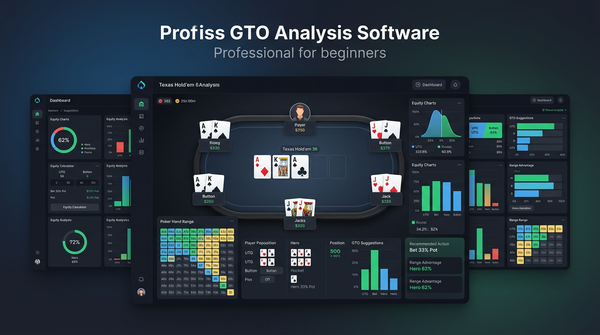
GTO Lab — ~$49/month or $399/year. My current daily driver. Browser-based, comprehensive cash game library, beginner-friendly interface, integrated trainer mode. The interface design is the most modern of the major solvers and the least intimidating for new users. The pre-solved spot library covers cash games at all common stack depths and 6-max/9-max formats well. Where it falls short: tournament coverage is thinner than GTO Wizard's, and the most advanced features (deep custom solving, advanced node locking workflows) are less polished than purpose-built desktop solvers like PioSolver.
GTO Wizard — $49–$99/month depending on tier. The market leader in pre-solved coverage. Cash, MTT, spin & gos, heads-up, satellites — all covered with extensive sims. The trainer mode is the best in the industry. Premium-tier subscription is required to unlock the most useful sims (cash deep-stack, advanced MTT spots). Expensive but earns its price for serious multi-format players. Less beginner-friendly than GTO Lab; the sheer depth of the library can be paralyzing.
InstaGTO — ~$29/month. Budget option. Cash-focused. Coverage is meaningfully thinner than GTO Lab or GTO Wizard but adequate for low-stakes regulars who only want cash spots. The interface is more dated. Good entry point if money is tight.
PokerSnowie — $29/month. Not technically a solver — it's a neural network trained to approximate GTO play. The interface gives red/yellow/green verdicts on every action, which is much more beginner-friendly than reading range matrices. Good for the first 3–6 months of GTO study; outgrown after that as you start needing actual solver outputs.
PioSolver / Simple Postflop — $200+ one-time desktop solvers. The OG tools that defined this category. Still excellent for advanced custom work, especially node locking and population-specific deviation studies. Steep learning curve. Require a beefy machine to run sims in reasonable time. Not where I'd start in 2026 — browser-based options have closed the gap.
Open-source (TexasSolver et al.) — Free. You build trees yourself. Not for beginners. If you're a software engineer who enjoys tinkering, fun. If you're a poker player who wants to improve, skip.
My recommendation matrix:
- True beginner with no solver experience: PokerSnowie for 2 months, then GTO Lab.
- Cash game regular at NL50–NL500: GTO Lab.
- Serious multi-format player or higher stakes: GTO Wizard premium tier.
- Budget-constrained cash player: InstaGTO.
- Advanced player doing custom population studies: PioSolver.
Category 2: Hand Tracking Software (HUD + Database)
If a solver is the centerpiece, your tracking database is the foundation. You can't fix leaks you can't see, and you can't see leaks without your own data.
The market in 2026 is dominated by three products:
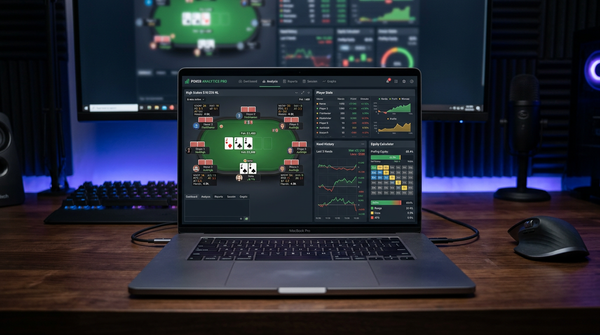
PokerTracker 4 — $99.99 one-time. My pick for most players. Best-in-class database analysis tools, deep filter capabilities, native Mac and Windows support. The HUD is good after customization, the in-game polish trails HM3 slightly. Pay once, use for years.
Hold'em Manager 3 — $99 one-time. Pretty interface, slightly nicer in-game HUD, NoteTracker for structured opponent profiles. Mac users go through a wrapper. Same price as PT4. Choose based on whether in-game polish or database depth matters more to you.
DriveHUD 2 — $99/year. The Bovada/Ignition specialist. If you play on Bovada-network sites, you have no other choice. Annual subscription model is annoying but the product works.
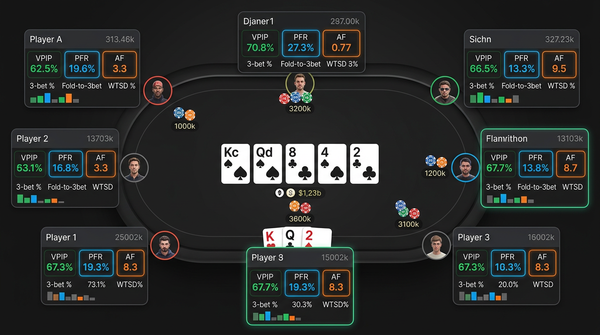
Hand2Note — Subscription tier (varies). Innovative range research feature, growing market share, especially among Russian site players. Steeper learning curve than PT4/HM3. Worth a look for advanced cash game players.
For a beginner with limited budget, free tiers exist. Hand2Note's free tier is genuinely free indefinitely (with database limits). PT4 and HM3 offer 30-day trials. Use the free tier for your first 50,000 hands to confirm you'll actually study your data. If you do, the $99 one-time investment in PT4 or HM3 is unambiguous value.
I run PT4. Have for years. Database is approaching 5 million hands. The customization I've built up over time is a sunk cost that makes switching expensive, but I genuinely think PT4 is the right tool for what I do.
Category 3: Training Sites and Video Content
Pre-solver era, this category was the dominant form of poker study. Run It Once, Upswing Poker, Raise Your Edge, the various sites with hundreds of hours of pro content. They're still around, still produce video content, and they have a real role — but a different one than they used to.
Upswing Poker — subscription with frequent course-style content. Course quality varies; Doug Polk's headline content is excellent, lower-tier instructors are mixed. Better for tournament players than cash. The "Lab" courses are generally worth the money for the specific topics they cover.
Run It Once — subscription model, content from various pros. Quality is high but inconsistent across instructors. Better for studying specific pro game styles than for learning systematic theory.
Raise Your Edge — tournament-focused. Excellent for MTT players. Less useful for cash specialists.
Poker Academy — broad-spectrum training site with a mix of solver-driven content and instructional video. The hybrid approach is appealing — you get both the theory videos and the solver work in one subscription.
Free YouTube content — has gotten dramatically better in 2026. Several top pros now post free content that's competitive with paid sites for foundational learning. You can build a meaningful base from YouTube alone for the first 6 months of study.
My honest view on training sites: they're worth it for the first 6–12 months of study, when you're building a base. After that, the return diminishes — you've absorbed the foundational material and additional videos teach you less per hour than equivalent solver work. I dropped my Upswing subscription in 2022 after using it for 18 months and don't regret it. But for a new player without a base, $30–$60/month for a training site is solid value.
Category 4: Equity Calculators
The unsexy foundation. Most low-stakes leaks are equity miscalculations, not GTO mistakes.
Equilab — free. Old, ugly, perfect for what it does. Calculate equity between hand ranges on any board. I've been using it for years and never had a reason to switch.
Flopzilla — paid one-time. Adds range-vs-range visualization on flop textures. More polished than Equilab but the core function is the same.
PokerJuice — for Omaha specifically. If you play PLO, this is the standard.
For most players, Equilab is enough. Don't overspend on equity tools — the value is in the act of calculating equity, not in the polish of the tool you use.
Category 5: Preflop Range Trainers
A focused subcategory. You need to know preflop ranges cold before any other study makes sense.
GTO Wizard / GTO Lab Trainer modes — included with the solver subscription. Drill ranges in the same tool you use for postflop study.
Pokercoaching.com / Range Trainer apps — standalone trainers. Sometimes free, sometimes paid. Useful if you don't have a solver subscription yet.
For someone with a solver subscription, the integrated trainer is fine. For someone without, free range chart apps and just-memorizing-published-charts works equally well.
Category 6: Course Bundles and Coaching
Premium individual courses ($200–$500 one-time) and one-on-one coaching ($100–$500/hour) are the highest-end options.
Premium courses: worth it for highly specific topics where you want a structured curriculum. The Mass Tabling Mindset, Doug Polk's various courses, Krzysztof Slusarz's MTT material. Lifetime access usually included.
One-on-one coaching: highest cost, often highest ROI for serious players who can identify specific blind spots. Most low-stakes players don't need it. Most mid-stakes players underuse it.
I've worked with one coach over the past three years for occasional sessions ($200/hour). It pays for itself in the spots he identifies that I'd never have caught alone. For most players, this is overkill until you're playing for real money at stakes where leak fixes are worth that hourly rate.
Category 7: Mental Game and Bankroll Tools
A category many players ignore until they have a tilt blowup.
The Mental Game of Poker (book series) — Jared Tendler's books are essential reading for any player who's ever tilted. Free at libraries, $20 each to buy. Highest ROI of any poker investment for emotional players.
Bankroll trackers — apps for tracking results, calculating bankroll requirements, monitoring variance. PT4 and HM3 do this within their database features. Standalone tools exist (Stax, etc.) but not necessary for most players.
Tilt protection tools — table-locking software, session timers, loss limits. Niche but worth knowing about for players with self-control issues.
I include this category because the mental game side of training is consistently underweighted relative to its impact on winrate. A player who avoids two tilt blowups a year saves more money than most software costs combined.
Comparison Tables
| Solver | Price (2026) | Best for | Learning curve |
|---|---|---|---|
| GTO Lab | ~$49/mo, $399/yr | Cash regs, beginner-friendly | Moderate |
| GTO Wizard | $49–$99/mo | Multi-format, advanced | Steep |
| InstaGTO | ~$29/mo | Budget cash players | Moderate |
| PokerSnowie | $29/mo | Pure beginners | Easy |
| PioSolver | $200+ once | Advanced custom work | Very steep |
| HUD | Price (2026) | Strength | Weakness |
|---|---|---|---|
| PokerTracker 4 | $99.99 once | Database depth | Dated UI |
| Hold'em Manager 3 | $99 once | In-game polish, NoteTracker | Mac wrapper required |
| DriveHUD 2 | $99/yr | Only option for Bovada | Subscription model |
| Hand2Note | Subscription | Range research | Steeper learning curve |
| Tool category | Essential? | Annual cost (typical) |
|---|---|---|
| Solver | Yes (after prerequisites) | $300–$1000 |
| HUD + database | Yes | $99 one-time |
| Training site | Useful for first year | $360–$720/yr |
| Equity calculator | Yes | $0 (Equilab) |
| Range trainer | Useful, often included | $0 if bundled |
| Premium course | Optional | $200–$500 once |
| Coaching | Optional, high-ROI | $100–$500/hr |
| Mental game books | Yes | $40 once |
| Player type | Suggested annual stack | Annual cost |
|---|---|---|
| Brand new (first 6 months) | Free tier HUD + free YouTube + Equilab | $0 |
| Building base (6–12 months) | PT4 ($99) + training site ($30/mo) | ~$460 first year |
| Low-stakes serious (NL25–NL100) | PT4 + GTO Lab | ~$520/yr ongoing |
| Mid-stakes regular (NL200–NL500) | PT4 + GTO Lab or GTO Wizard | $520–$1200/yr |
| Multi-format pro | PT4 + GTO Wizard premium + occasional coaching | $1500–$3000/yr |
What I Actually Use Right Now
To put my money where my mouth is, here's my current 2026 stack:
- HUD: PokerTracker 4 (paid once in 2019, no ongoing cost)
- Solver: GTO Lab (annual subscription, $399/year)
- Equity: Equilab (free)
- Notes: Apple Notes for personal study log, no dedicated software
- Coaching: Roughly one $200 session per quarter
- Mental game: Tendler's books on rotation
Total annual cost: about $800. Hands played: ~80,000/year at NL200-500. The math works easily — software is a small fraction of overall edge generation.
What I dropped over the years:
- Upswing subscription (dropped 2022): not enough new material relevant to my game.
- PokerSnowie (dropped 2020): outgrew it once I could read solver outputs.
- Premium MTT courses (dropped 2019): I'm a cash specialist, didn't apply.
- Multiple HUDs (settled on PT4 in 2019): switching costs not worth marginal differences.
The subtractive lesson: most of my improvement came after I stopped buying new software and committed to using fewer tools more deeply.
Common Mistakes Players Make Buying Training Software
A few patterns I see consistently.
Buying everything because it's tax-deductible. I literally see this on Twitter every January. "Got my new bundle of solver + course + tracker, all deductible." If you're not using it, deductibility doesn't matter.
Buying based on feature lists. The product with the most features is usually not the best for your specific situation. Features you don't use don't help.
Subscribing then never opening. The most common failure mode. Subscription decays your discipline because there's no friction to "use it more." A one-time purchase forces you to commit upfront.
Buying a course before mastering free content. YouTube has hundreds of hours of high-quality free content. A $300 course is rarely better than free content + 100 hours of focused practice.
Switching tools every six months. Switching costs are real. Every new HUD, new solver, new training site requires hours to set up and learn. The marginal benefit rarely justifies the disruption.
Buying coaching before you know what you don't know. A coach is expensive. Use them once you have a database, identified leaks, and specific questions. Otherwise you waste sessions on basics you could learn from cheaper sources.
What I'd Buy If Starting Over Today
If I were a new player in 2026 with a $500/year budget and aiming to be a serious low-stakes cash regular:
Year 1 stack ($560 total):
- PokerTracker 4: $99.99 one-time
- One training site for 12 months: ~$360
- Tendler's mental game books: $40
- Equilab + free YouTube content: $0
Year 2 stack ($499 ongoing):
- Drop training site (you've absorbed the base)
- Add GTO Lab annual: $399
- Maintain PT4 and Equilab: $0 ongoing
- Mental game maintenance: $0
Year 3+ stack:
- Same as year 2, plus occasional coaching as needed.
This produces a player with strong fundamentals, an active database, modern solver-driven study, and emotional control. Total three-year cost: ~$1,500. For a player serious about poker at NL50+, this pays back many times over.
The version of this stack people actually buy is double the cost and produces worse results because they spread study time across too many tools.
The Verdict
In 2026, the right poker training software stack for most improving players is small and focused: a solid HUD (PokerTracker 4 or Hold'em Manager 3), a single solver (GTO Lab for most cash regulars, GTO Wizard for multi-format), and free supporting tools (Equilab, YouTube content, Tendler's books). Everything beyond that is either situational or premature.
The biggest mistake isn't picking the wrong tools. It's owning too many and using them shallowly. The player who runs one solver for 200 hours will improve more than the player who dabbles in four for 50 hours each. Pick a stack. Commit to it for at least a year. Use it deeply. Then evaluate.
If you're a complete beginner, start with free tools and a HUD. After 50,000 hands, add a solver. After 100,000 hands, evaluate whether your study time is producing measurable improvement. If yes, deepen. If no, the problem isn't your software — it's your process.
Stop buying. Start studying. The tool that's already on your laptop is probably enough.
A Week in My Study Routine Across the Whole Stack
To make the abstract concrete, here's how my four tools (PT4, GTO Lab, Equilab, mental game books) actually combine in a typical week. This isn't aspirational. It's what's on my calendar.
Monday morning, 50 minutes. Open PT4. Filter for last week's losing sessions. Identify the one stat that's drifted furthest from baseline. Last week it was my fold-to-3bet from CO, which had crept up about 4% over a 20K-hand sample. That's a real signal. Open GTO Lab. Look at solver-correct fold-to-3bet from CO. Compare. The stat says I'm folding too much. Spend the rest of the session looking at the specific hands I should be calling or 4-betting that I've been folding.
Tuesday evening, 15 minutes. GTO Lab trainer mode. Random spots, no theme. Just reps. Score 76% accuracy. Note the worst category was river decisions in single-raised pots — particularly facing overbets.
Wednesday morning, 35 minutes. Equilab session. Pulled three river overbet hands from Sunday's session. Built villain's likely range based on prior actions. Calculated my equity vs that range. Two of the three calls were marginal but defensible. One was a clear fold I'd talked myself into calling. That hand cost me half a buy-in. Now I know the equity math better.
Thursday morning, 40 minutes. GTO Lab. Comparative study. Picked single-raised pots, BTN vs BB, on rainbow ace-high flops. Looked at five different ace-high textures: A72r, AT4r, AK7r, A85r, AJ3r. Pattern: cbet frequency stays high but sizing diverges. The two-pair-blocker boards (AT4, AJ3) want smaller sizings; the dry uncoordinated boards (A72, A85) want bigger sizings. I'd been using one size across all of these.
Thursday evening, 10 minutes. Trainer reps focused on ace-high flops in BTN vs BB. Accuracy on this subset jumped from baseline 73% to 86% after the focused session. Reps work.
Friday morning, 65 minutes. Hand history review. Pulled five hands from the week. Three were ace-high flop cbet sizing decisions (the thing I'd just studied). Two were unrelated. Documented what I'd do differently. Total EV left on the table across the five hands: about 5.4bb. At NL500 that's $27 of pure leak. The week's study just paid for itself.
Saturday and Sunday, 0 minutes structured. Just play. Maybe a Tendler chapter on the train if I'm traveling. The week's data feeds Monday.
Total weekly time across the stack: about 3 hours 35 minutes. PT4 is the data source, GTO Lab is the analysis tool, Equilab is the equity backstop, the trainer is the reinforcement loop. Four tools, one routine, sustained for years.
The Spots Where Each Tool Shines Most
A more granular pass on what each tool is actually best at, based on years of pulling them out for different problems.
PokerTracker 4 is best at:
- Filter-based exploration ("show me every hand where I 3-bet OOP and lost more than 1bb on the river")
- Long-run stat tracking against named regulars
- Sample-size sanity checks ("is my 23% 3-bet from CO real or variance?")
- Custom report building for specific leak categories
- The hand replayer for visualizing complex multi-street action
GTO Lab is best at:
- Specific spot lookups ("how should I play AKo on this turn in this pot?")
- Comparative pattern recognition across similar textures
- Hand history reruns where I want to see EV gaps
- Trainer mode for daily reinforcement
- Building intuition for unusual stack depths or formats I don't play often
Equilab is best at:
- Pure equity calculations vs hand ranges
- Quick "am I getting the right price to call?" sanity checks
- Equity-vs-range visualizations for spots that don't need full GTO solving
- Sample range analysis (what's my hot/cold equity vs villain's likely range?)
Tendler's mental game books are best at:
- Tilt pattern identification (it's never the obvious trigger)
- Long-form perspective during downswings
- Pre-session and post-session ritual design
- Reframing variance in a way that actually helps
The point of having a focused stack isn't that each tool does everything — it's that each tool does its specific job extremely well. When I need equity calculations, I don't try to grind them out in GTO Lab. When I need leak detection, I don't try to recreate it in Equilab. Each tool gets used for what it's best at.
What I'd Tell Someone Buying Their First Stack
If you'd just decided to get serious about poker software and you asked me what to do, this is the unfiltered version.
Don't buy a solver first. Buy PokerTracker 4 first. Without your own database, solver work has no foundation. You'll be studying generic spots disconnected from your actual leaks. Get the database, build it for two months minimum, then add the solver.
Don't buy multiple tools in the same category. Pick one HUD. Pick one solver. Pick one equity tool. Switching costs are real and the marginal benefit between top-tier products is small.
Don't subscribe to a training site for the first month. Free YouTube content is competitive enough that the first 30 days of foundational learning don't need to cost you anything. Spend the budget on PT4 instead.
Don't pay for coaching until you have specific questions. A coaching session is $200–$500 of largely wasted money if you don't show up with concrete leak data and specific questions. Build that data first; use coaches for targeted second opinions.
Do buy Tendler's books. Cheap, high-impact, durable. The Mental Game of Poker has paid for itself many times over by helping me avoid tilt blowups that would have cost more than the book ten times.
Do whitelist your HUD in your antivirus. Windows users especially. Antivirus is the #1 reason new HUDs "don't work." Five minutes of setup prevents hours of debugging.
Do back up your database weekly. Database corruption happens. Weekly automated backup to an external drive or cloud folder turns "catastrophic" into "annoying."
Do commit to a year minimum. Switching tools every six months means you never master any of them. The compounding benefits of deeply knowing one HUD's filter system or one solver's library structure take a year to manifest. Don't shortchange yourself.
Six Months Later: Has Anything Changed in My Stack?
I wrote a version of this article for a coaching client roughly six months ago and the stack hasn't changed. I'm still on PT4, still on GTO Lab, still on Equilab, still rotating Tendler's books. The total cost is still about $800/year. What has changed is how I use them.
More trainer reps, less solver deep dives. I went from 90 minutes of solver work weekly to 60 minutes, and added 30 minutes of trainer reps. The accuracy gain at the table from sustained trainer work has been measurable. Solver work compounds slower; trainer work compounds faster but plateaus earlier. I needed more of the latter than I'd been doing.
More equity calculations, fewer assumptions. I used to wing equity math at the table. After getting burned on a few river overcalls, I've made Equilab a more frequent part of post-session review. Five minutes of equity work on a confusing hand is cheaper than the next $100 leak.
Coaching sessions less frequent. I've gone from quarterly to semi-annually. Not because I don't value coaching — I do — but because the leaks I can identify on my own from the PT4 + GTO Lab combination are most of what I need. Coaching gets reserved for spots where I genuinely don't see the answer.
Mental game more frequently than ever. I read at least one Tendler chapter per month, sometimes more. The closer I get to the top of my game, the more leverage there is in the mental side. Most leaks at NL500+ aren't technical anymore; they're emotional.
The bigger pattern: my stack didn't grow. My usage of it deepened. That's the right trajectory for any improving player. Add fewer tools. Use them more.
If you're starting fresh today, my recommendation in six months will probably be the same one I'm giving now. PT4 + GTO Lab + Equilab + Tendler. Around $800/year for the serious player. Consistent use beats clever buying every single time.