PokerSnowie Review 2026: The AI That Doesn't Use Solvers
PokerSnowie in 2026 from a NL200-500 reg. Why this AI thinks differently than solvers, where the $29/month subscription pays off, and where it'll mislead you.
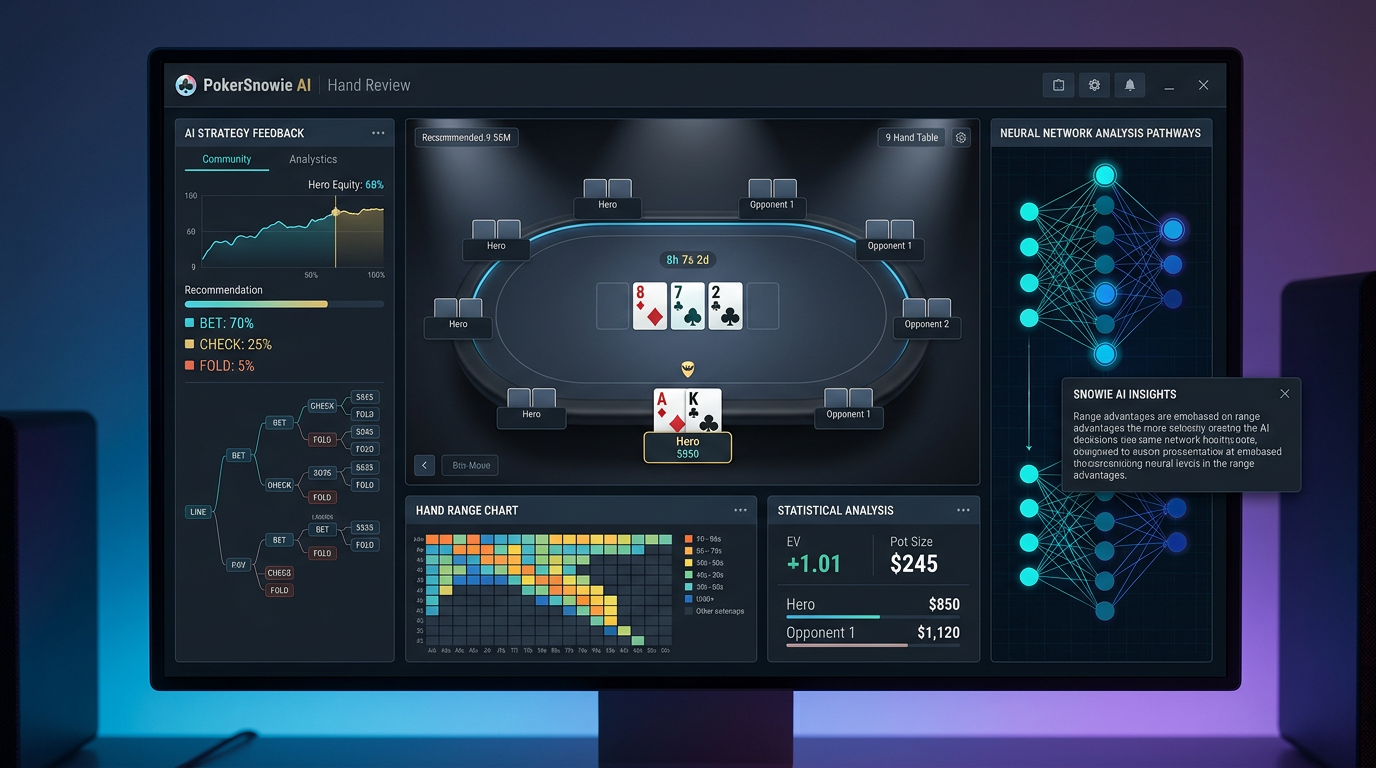
PokerSnowie Review 2026: The AI That Doesn't Use Solvers
There's a popular take in the poker community that goes something like this: PokerSnowie is outdated, GTO solvers are better, and anyone still paying for PokerSnowie in 2026 is wasting their money. I want to push back on that take because it's mostly wrong, and I want to explain why with specifics.
Let me set the scene. I'm Alex, 9 years online cash regular, currently at NL200-500. My primary study stack is GTO Lab plus PokerTracker 4 plus a paid subscription to PokerSnowie. The reason I have all three running is that they do different things. The reason I'm writing this review is that a lot of players are talking about PokerSnowie as if it's a worse version of GTO Lab, which fundamentally misunderstands what PokerSnowie is.
PokerSnowie is not a solver. It is a self-play neural network trained over billions of hands of synthetic play. The output of that training is a model that makes decisions in real time. The decisions are not GTO. They're whatever the network learned converges to, which is close to GTO in many spots and meaningfully different in others.
That difference is the point. PokerSnowie isn't competing with solvers — it's a different tool that happens to also tell you what to do in poker spots. If you understand the difference, the question of whether to pay $29/month for it becomes much more nuanced than "GTO is better, skip Snowie."
I've kept a PokerSnowie subscription on and off for the past three years. Right now I'm in an "on" phase that's lasted about 9 months. This review is what I've learned about when PokerSnowie genuinely helps and when it'll lead you astray.
What PokerSnowie Actually Is (Technically)
Most reviewers gloss over the technical details. I'm going to dig into them briefly because they matter for understanding when to trust the output.
PokerSnowie is a neural-network-based AI. The team behind it spent years (starting around 2011) training a network through self-play. The training methodology is similar to what AlphaGo's team used for Go — let the network play against itself, score the outcomes, update the weights, repeat. After enough iterations the network converges toward a strategy that's strong but not necessarily game-theoretically optimal.
This matters because the output of this training process isn't the same as the output of a solver. A solver computes the equilibrium directly. PokerSnowie approximates whatever its self-play converges to, which is heavily influenced by:
- The network architecture
- The reward function
- The hyperparameters
- The size of the training compute budget
The result is a strategy that's strong, exploitable in some spots by a true GTO opponent, and importantly — performs differently than GTO against the realistic player pool you actually face.
That last point is critical. GTO is "unexploitable in theory." But in practice, against a player pool that itself isn't GTO, GTO play leaves money on the table compared to exploitative play. PokerSnowie's strategy isn't GTO, but it also isn't trying to maximally exploit any specific opponent — it's a balanced strategy that happens to converge to something close-ish to optimal play.
For some learning purposes this is actually more useful than GTO. For others it's less useful. I'll get specific below.
The Pricing
PokerSnowie keeps a simple pricing structure that hasn't changed much over the years:
| Plan | Monthly | Yearly | What's Included |
|---|---|---|---|
| PokerSnowie Pro | $29 | $290 | Full Snowie engine, advisor, trainer, ranges, drills |
| Bundle with Coach | $39 | $399 | Snowie Pro + interactive coaching modules |
| 7-day free trial | Free | — | Full access, no credit card initially |
The Pro plan at $29/month or $290/year is the standard subscription most users pick. Annual gets you a discount of about $58/year compared to month-to-month, so if you're confident you'll use it for a full year, pay annually.
The Coach bundle adds interactive learning modules that walk you through specific concepts with Snowie's advisor providing real-time feedback. The modules are reasonable but I'd skip them unless you specifically value structured learning content — for which I'd actually point you at Poker Academy instead.
In CAD/AUD/NZD/GBP/EUR:
- ~$395 CAD / $445 AUD / $485 NZD / £230 GBP / €270 EUR per year for Pro
That's roughly half the cost of a GTO Lab Standard subscription, which positions Snowie as the more affordable AI-driven training tool.
What PokerSnowie Does Genuinely Well
This is where I want to push back hardest on the "Snowie is obsolete" narrative.
1. Conceptual Training Is Better Than Solvers For Beginners
This is the case that almost everyone misses. If you're new to poker theory — say you understand position and ranges but you don't yet have intuition about polarized vs merged bet sizings, blocker effects, or river bet-bluff ratios — a GTO solver will overwhelm you. The output is precise but it doesn't explain.
PokerSnowie's advisor mode is the opposite. You play through hands. The advisor shows you Snowie's recommended action, the equity of your hand, the range Snowie thinks you should have, and a brief explanation of why. The explanations are simpler than what you'd extract from a solver, and they're framed in a way a developing player can understand.
I've recommended Snowie to several beginner-to-intermediate players over the years and the feedback is consistent: they actually use it. They don't actually use GTO solvers in the early stages because the interface intimidates them and the learning curve is steep. Snowie meets them where they are.
For an experienced player (NL100+), this conceptual advantage matters less because you already have the intuition Snowie's trying to build. But for a NL10-NL50 player working on fundamentals, Snowie is more useful than GTO Lab, full stop.
2. The Advisor Mode During Self-Play
PokerSnowie's Trainer is a play-mode where you play hands against the AI, get real-time advice on each decision, and see EV comparisons between your action and Snowie's recommendation. This is different from GTO Lab's quiz mode in an important way.
In GTO Lab you're being shown spots and asked to make decisions. The spots are weighted toward your weaknesses but they're discrete — each hand stands alone. In Snowie's Trainer you're playing continuous sessions, so the decisions are contextualized by the flow of play. You're more likely to encounter the kinds of multi-street decision sequences that actually happen in your games.
For pattern recognition this is genuinely better than discrete quiz mode. I use Snowie's Trainer specifically when I want to work on session-level discipline rather than individual spot accuracy.
3. Range Visualization
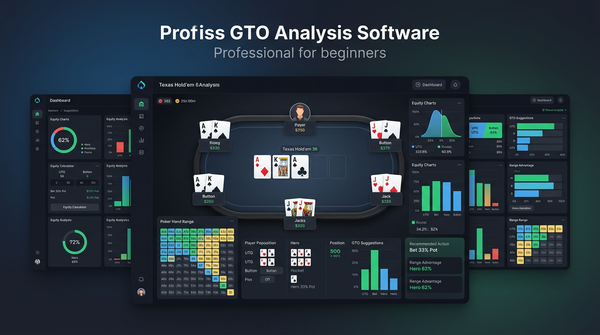
Snowie's range tools are good. You can see Snowie's recommended ranges by position and action sequence, color-coded by frequency of each combo. The visualization is clearer than what most GTO tools provide because it's optimized for understanding rather than for precision.
For learning ranges, particularly opening ranges and 3-bet ranges in 6-max, Snowie's visualizer is one of the better tools I've used.
4. It Models A Realistic Strategy, Not Just GTO
This is the philosophical point and I want to develop it. A GTO solver's output is the equilibrium strategy. Against a GTO opponent, it's unexploitable. Against a non-GTO opponent — i.e., everyone you actually play against — it leaves money on the table.
Snowie's strategy converged through self-play, which means it implicitly handles certain situations the way a strong real player would handle them rather than the way pure theory would. In some spots this means Snowie deviates from GTO in directions that happen to better exploit the typical online player pool.
This is the most controversial claim I'll make in this review and I want to be careful with it. I'm not saying Snowie is "better than GTO." I'm saying Snowie's strategy is closer in some specific ways to what a realistic strong opponent looks like, which makes practicing against Snowie a different (and complementary) exercise to studying GTO outputs.
For a player who already has GTO fundamentals locked in, Snowie can be useful as a "what would a strong human do here" reference point, distinct from "what does the solver say."
5. It Runs Fast And Reliably
PokerSnowie is a mature product. The desktop application runs reliably on Windows and Mac, the cloud version works in any browser, and the UI is functional if dated. I've had maybe two crashes in 9 months of use. That's about as good as poker software gets.
What PokerSnowie Does Poorly
I have to be specific about the failures.
The UI Looks Like 2014
PokerSnowie's interface has barely changed visually in years. It's not as offensively dated as PT4's UI, but it's clearly not designed for 2026 displays. Text rendering is rough on Retina screens, the layout doesn't scale gracefully, and certain panels feel cramped.
This is cosmetic but it affects the experience. New users sometimes assume the product is abandoned because the UI looks unmodern. It isn't abandoned — there are regular updates — but the UI hasn't been a priority.
The Strategy Has Visible Holes Against Modern Theory
This is the substantive critique. Snowie's neural network was trained years ago and the strategy reflects that. In certain spots — specifically river decisions in deep stack play, blocker-heavy river bluffs, certain 4-bet pot scenarios — Snowie's recommendations diverge from current GTO understanding in ways that suggest the model has learned suboptimal patterns.
I've cross-checked Snowie's recommendations against GTO Lab's solutions for about 30 specific spots over the past year. In most spots they agree. In about 15-20% of spots they disagree, and in most of those cases the GTO solution is more clearly correct than Snowie's.
For training purposes this is manageable — you can use Snowie for the spots where it agrees with GTO and ignore its recommendation in the spots where it doesn't. But you need to know that this dynamic exists. A player using Snowie alone without a solver to cross-check could absorb suboptimal patterns.
It Doesn't Have A Solver Mode
This sounds obvious — Snowie is not a solver — but it's worth saying explicitly. If you want to ask "what's the GTO solution to this specific spot," Snowie can't answer. You need to use a solver alongside it. The combination of Snowie + a solver is the right setup if you can afford both.
Hand History Import Is Limited
Snowie supports hand history import but the parser is less robust than what PT4 or HM3 offer. Hand histories from some sites parse cleanly; others have issues. If your primary use case is "import my hands and have Snowie review them," you'll find friction.
I do most of my hand review in GTO Lab's analyzer (or in HM3's reports) rather than Snowie's. Snowie shines more in the Trainer mode than in retrospective hand review.
No Population Adjustment
This is the feature that's most clearly missing. Snowie's strategy is one strategy. It doesn't adjust based on opponent tendencies, and it doesn't expose any way for you to ask "what if my opponent over-folds rivers by 12%, what should I do?" GTO Lab's Population Deviator covers this. PokerSnowie doesn't.
For a player who's already comfortable with baseline strategy and wants to dig into exploitation, Snowie won't help. You need a different tool.
The Coach Bundle Modules Are Mediocre
I tried the Coach bundle for a few months last year. The interactive modules are fine but not exceptional. The content tends to lag current best practice and the production quality is uneven. If you're looking for structured course content, Poker Academy does it better.
How I Use PokerSnowie In My Routine
Here's my actual workflow. It's deliberately different from how I use GTO Lab.
Daily Trainer Session (30 minutes)
Most mornings I do 30 minutes in Snowie's Trainer. I play a continuous session of 30-50 hands against the AI, with the advisor turned on but in "delayed feedback" mode — I make my decision, then see Snowie's recommendation. This is rapid practice, not deep study.
The point isn't to memorize Snowie's specific actions. The point is to build pattern recognition through repetition. After enough sessions, the right action in common spots becomes automatic, which frees up mental capacity during real play for the harder decisions.
Range Drilling (15 minutes, 2-3x/week)
A few times a week I work specifically on ranges. Snowie's range visualizer is my preferred tool for this. I pick a position (typically a problem area — say, UTG raising ranges or BB calling ranges vs CO opens) and drill 50 combos at random.
Cross-Reference Against GTO Lab
When Snowie's recommendation surprises me, I cross-reference against GTO Lab. About 80% of the time they agree and I learn something. About 20% of the time they disagree and I trust GTO Lab over Snowie. Over time this calibrates my sense of which spots Snowie is reliable on.
Coach Mode Sparingly
I don't use Coach mode much. When I do, it's for revisiting a specific concept I want refreshed — there's a module on "river bet sizing as a function of polarization" that I've revisited three times because it explains the concept in a way that sticks.
Snowie vs The Alternatives
| Tool | Cost/Year | Strength | Weakness |
|---|---|---|---|
| PokerSnowie | $290 | Conceptual training, real-time advice | Not GTO-correct in all spots |
| GTO Lab | $399 | True GTO solutions, deep analysis | Less beginner-friendly |
| GTO Wizard | $588+ | Comprehensive, mobile-friendly | More expensive |
| InstaGTO | $348 | Fast custom solves | Not a learning environment |
| Poker Academy | $299 | Video-led curriculum | No interactive AI element |
The pattern: each tool serves a different study purpose. They're not interchangeable. The question isn't "Snowie or GTO Lab" — for a serious player it's "which combination of Snowie, GTO Lab, and Poker Academy gives me the right coverage for what I'm trying to learn."
For a beginner with one budget line, I'd pick Snowie over the others because it's the most accessible.
For an experienced player with three budget lines, I'd run Snowie + GTO Lab + Poker Academy.
Common Questions
Is PokerSnowie still relevant in 2026? Yes, for specific use cases. For beginners learning fundamentals it's still the most accessible tool. For experienced players it's useful as a complement to GTO solvers, not a replacement.
Will Snowie make you a winning player? It can contribute, but it's not a complete study solution. You need to also be playing volume, reviewing your own hands, and ideally have a tracker. Snowie is one piece of a study stack.
Is Snowie's advice GTO? No, and the team has never claimed it was. Snowie's strategy converged through self-play, which approximates GTO in many spots but diverges in others. If GTO correctness is critical for you, use a solver instead.
How does Snowie compare to GTO Wizard's free tier? GTO Wizard's free tier gives you a small library of GTO solutions to browse. Snowie gives you an interactive AI to play against. Different products. The free Wizard tier is fine for casual reference; Snowie is more useful for active practice.
Can you use Snowie alongside a solver? Yes, and you should. They're complementary tools. Use Snowie for active practice and pattern building; use a solver for verification and deep analysis.
Does the 7-day free trial give you full access? Yes. You can test the full product before paying. They've kept this trial available consistently.
Will it run on Mac? Yes. The desktop app works on macOS. The cloud version works in any browser regardless of OS.
What's the difference between the standalone app and the cloud version? Functionally similar. The standalone app is faster locally; the cloud version syncs across devices. Pick based on whether you play across multiple machines.
Should you cancel and re-subscribe periodically? Not a bad idea. Snowie's content doesn't change rapidly, so once you've worked through it for several months you've extracted most of the value. I've cycled on and off the subscription based on my study focus.
How long does it take to see results? If you're a beginner, 4-8 weeks of regular use will materially improve your fundamentals. If you're already strong, the marginal improvement is smaller and slower — maybe a few months for the pattern recognition to translate into measurable win rate gains.
Is the company still developing it actively? Yes. Updates aren't frequent but they're real. The team is small but active.
Verdict: A Different Tool For A Different Purpose
After 9 months on my current subscription, I'll keep paying for PokerSnowie through at least the end of 2026. The Trainer mode genuinely improves my pattern recognition for everyday spots, the range visualizer is the cleanest in the category, and the $290 annual cost is reasonable for a tool that gets daily use in my routine.
But — and this is the important caveat — I don't recommend Snowie as a standalone study tool for experienced players. It needs to be paired with a GTO solver to cover the spots where Snowie's recommendations diverge from current theory. Snowie + GTO Lab is a stronger combination than either alone.
For beginners and developing players (NL10-NL100), PokerSnowie is actually my top single-tool pick. The interface is more accessible than GTO Lab's, the advisor explains decisions in ways a developing player can absorb, and the $29/month cost is the cheapest serious-poker AI subscription available. A new player who works through Snowie for 6 months will come out the other side with substantially better fundamentals than a new player who tried to learn from a GTO solver.
For experienced players, Snowie is a supplement, not a foundation. Add it to your stack if you want a fast-paced practice mode and a complementary perspective on strategy. Skip it if you've already got a solver workflow that's working and you don't have the budget for another tool.
The product has genuine flaws — dated UI, divergence from current GTO theory in specific spots, weak hand history import — and these are getting more pronounced as the broader software ecosystem improves around it. If the team doesn't ship a significant update in the next 12-18 months, PokerSnowie may genuinely become hard to recommend. As of mid-2026, though, it still has a place in a serious study stack.
The 7-day free trial costs nothing. If you're curious, just try it. Twenty minutes in the Trainer will tell you whether the interactive practice style fits how you learn. If it does, the subscription is worth the money. If it doesn't, you've lost a week.
A Week In My Snowie Routine
I want to give you a concrete picture of what regular use actually looks like, because vague claims like "I use it daily" don't help you decide whether the rhythm fits your life.
Monday is my heaviest study day. I don't play Mondays — Sundays are big volume days for me on the Asian-facing networks, and Monday is recovery and reflection. I open Snowie around 9 AM with coffee. First 30 minutes is the Trainer, no advisor visible. I play through 40-50 hands as if it were a real session. Then I rerun the same Trainer queue with the advisor turned on and walk through every spot where my action differed from Snowie's. That second pass is the actual learning. The first pass is calibration — am I making the decisions I think I'm making, or am I drifting?
Tuesday and Thursday I do shorter sessions, 20 minutes each, focused on a specific weakness I've identified. Most recently that's been BB defense versus 2.2x opens at 100bb effective with a deep cold-caller behind. Snowie's range visualizer lets me drill that exact node — pick a position, lock the opening sizing, and see the recommended defending range. I cycle through 30-40 hands in that node and stop.
Wednesday is hand history review day. I don't use Snowie much on Wednesdays. I'm in HM3 and GTO Lab. Snowie sits closed.
Friday is range work. I pick one position-vs-position spot per week and drill it for 25 minutes. The visualizer color-coding makes this faster than working ranges by hand or in a chart trainer like GTO Trainer Pro.
Saturday is volume day, no study. Sunday is volume day, no study. The week resets Monday.
Total time in Snowie per week: about two hours. That's the pattern that's stuck for nine months. I've tried "study Snowie an hour every day" and it's too much; the marginal value of hour 5 in a week is roughly zero compared to hour 2. Two focused hours is the sweet spot.
The Spots I Study Most In Snowie
A few specific spot families where Snowie has noticeably moved the needle for me. Sharing these because they might point you at where the tool actually delivers value.
BB defending vs SB limp-completes on dry boards. This is a spot I used to play poorly because the population in my pool over-folds these flops. Snowie's recommendation here is more aggressive than I was playing, and after drilling it for two weeks I recovered a measurable amount of EV.
Turn check-raise sizing in single-raised pots. Specifically OOP on disconnected boards like K72r turning a 4. Snowie's sizing recommendations here cluster around overbet and small-bet — bipolar — and that bimodal pattern is something I hadn't internalized from solver work alone. The Trainer drilled it into me through repetition.
SRP river spots after we c-bet flop and turn checked through. This is a node where I was over-bluffing rivers because I'd lost the line. Snowie's range tools showed me what my actual range looks like at that node and the bluff frequency I was running was wrong by a clear margin.
3-bet pot SRP-style flops in position. Boards like 953r where the 3-bettor's range is condensed. Snowie's recommendation here diverges from my old habits in useful ways.
I want to be specific because "I use Snowie and it helps" is the kind of vague endorsement I hate reading in other reviews. The spots above are where I can point to a concrete behavior change and say Snowie's training mode caused it.
What I'd Tell Someone Buying Snowie For The First Time
Practical gotchas that aren't on the marketing page.
Skip the Coach bundle initially. The interactive modules are mediocre and the price difference adds up. Get Pro at $29/month, decide after 60 days whether you'd actually use Coach content, then upgrade if yes.
Turn off the auto-advance in the Trainer. The default settings race you through hands. Slow it down. Sit on each decision for 15-30 seconds. The point isn't volume; it's pattern building.
Don't use Snowie's hand history import as your primary review tool. It's the weakest part of the product. Use HM3 or PT4 for hand history work; use Snowie for the Trainer and the range visualizer.
Treat the EV deltas as directional, not absolute. Snowie shows you the EV gap between your action and its recommended action. Don't read those numbers as gospel — they're computed within Snowie's strategy, which isn't strict GTO. They tell you which action is favored, not how favored.
Don't compare Snowie's output to GTO Lab on every hand. Pick a few specific nodes per week to cross-reference. Trying to verify every Snowie recommendation against a solver kills your study throughput.
The cloud version sometimes lags during peak hours in EU evening. If you're studying then and the latency bothers you, switch to the desktop app. Same content, no network dependency.
How Snowie Fits Into A Broader Study Stack
For the cash players I know personally, the strongest budget-conscious stack right now looks like this:
| Layer | Tool | Why |
|---|---|---|
| GTO truth | GTO Lab Standard | Ground truth for spot solutions |
| Pattern practice | PokerSnowie Pro | Daily Trainer + range drilling |
| Hand database | HM3 or PT4 | Track and review your actual play |
| Custom solves | InstaGTO Standard (optional) | Fill the gap when GTO Lab library doesn't cover |
Snowie sits in the "pattern practice" layer. It's not the truth source — GTO Lab is. It's not the database — your tracker is. It's the daily reps tool. Treat it like a batting cage: the cage doesn't teach you to hit, it gives you reps so the swing is automatic when the pitch comes.
The mistake I see new students make is trying to use Snowie as the truth source. They drill Snowie for months, internalize Snowie's strategy, and then get a rude surprise when they see GTO Lab's solution and it differs. The way to avoid that is to know upfront that Snowie is a practice tool whose strategy approximates GTO without being GTO. The Trainer's value is the rep cadence, not the precise correctness of every recommendation.
After Nine Months: My Honest Assessment
I'll keep paying. The Trainer's contribution to my pattern recognition is real and measurable. The range visualizer is the best in its category. The price is fair.
But I'd describe my satisfaction as 7/10, not 10/10. The dated UI grates. The lack of population awareness limits the tool. The divergence from current GTO theory in some specific spots requires constant cross-referencing. None of these are dealbreakers; together they keep me from calling Snowie a love affair.
If the team shipped a substantial UI refresh and added a "compare to GTO" mode that flagged spots where Snowie's recommendation diverges from a solver's, I'd be at 9/10 and recommending Snowie unequivocally. As of mid-2026 it's a strong specific recommendation for specific use cases, with caveats. That's how I think about it and how I'd want a friend to think about it before they swipe their card.